The Physics of Lightweight Armor: Structural Limits and Ballistic Trade-Offs of Aluminum
Aluminum alloys are vital for modern combat armored vehicles due to their lightweight properties. However, engineers face strict design limitations when using them for ballistic protection.
Here is a detailed breakdown of the limitations of aluminum armor and a specific comparison between two dominant military alloys: 5083 and 7039.
Introduction
Modern military strategy demands rapid deployment and high mobility. Heavy steel-armored vehicles often struggle with weight limits during air transport and cross-country maneuvering. To solve this, defense engineers frequently turn to aluminum alloys to build lightweight combat vehicles. While aluminum successfully cuts vehicle weight by up to 30%, it is not a perfect material. Designers must carefully balance its weight-saving benefits against severe structural and thermal limitations.
Key Limitations of Aluminum Alloys in Armored Vehicles
- Thickness Requirement: Aluminum requires greater physical thickness than steel to achieve the same ballistic protection. This increases the vehicle’s external dimensions and hull volume.
- Structural Volume: Thicker plates take up more space. This limits internal room for crew, electronics, and ammunition.
- Thermal Sensitivity: Aluminum loses structural strength at high temperatures. Exposure to fires or thermal weapons can cause rapid hull failure.
- Spalling Effects: High-velocity impacts can cause the inside face of the armor to flake off. These flying fragments (spall) severely injure the crew inside.
- Welding Degradation: Heat from welding softens the zones around the joints. This creates localized weak points with reduced ballistic resistance.
Specific Comparison: 5083 vs. 7039 Aluminum Alloys
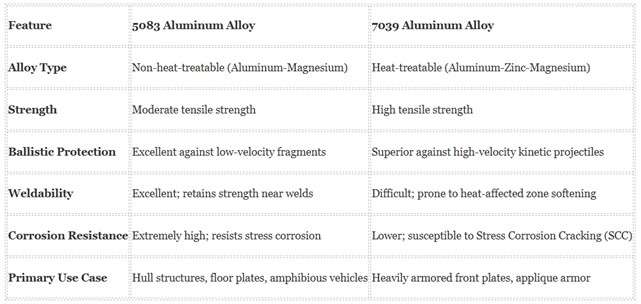
Structural and Ballistic Trade-offs
The primary challenge of aluminum armor is its density-to-thickness ratio. Aluminum is roughly one-third the weight of steel, but it is also softer. To stop the same armor-piercing round, an aluminum plate must be significantly thicker than a steel one. While the vehicle remains lighter overall, the extra thickness bulks up the vehicle’s exterior. This larger profile makes the vehicle an easier target on the battlefield.
Furthermore, welding changes the atomic structure of high-strength aluminum. The areas around welded seams lose up to 30% of their original hardness. If a vehicle is hit near a weld joint, the armor is much more likely to fail. Engineers must use complex geometric overlapping or mechanical fasteners to protect these weak zones.
Environmental and Thermal Risks
Aluminum behaves poorly under extreme heat. While steel can withstand high temperatures, aluminum alloys begin to weaken at temperatures as low as 150°C to 200°C. In the event of an improvised explosive device (IED) blast or a thermobaric weapon strike, the heat can cause the structural frame to sag or collapse. Additionally, certain high-strength aluminum alloys suffer from Stress Corrosion Cracking (SCC). Over years of service in hot, humid, or salty environments, microscopic cracks can develop under structural loads, causing sudden failures without warning.
Conclusion
Aluminum alloys remain indispensable for making combat vehicles agile and transportable. However, they cannot completely replace steel or advanced ceramics. Material selection is always a compromise. Non-heat-treatable alloys like 5083 offer reliable durability and ease of manufacturing for support vehicles. Meanwhile, high-strength alloys like 7039 provide the heavy ballistic resistance needed for front-line combat, despite their sensitivity to corrosion. Future armored vehicle design will rely on hybrid armor systems that combine the best traits of aluminum, steel, and composites.
Sources for Verification
Research Papers and Ballistic Reports
- Ballistic Performance History: The comprehensive defense study Expanding the Availability of Lightweight Aluminum Alloy Armor published by the DTIC details the military adoption of 5083 for the M113 APC, the shift to 7039 for the XM551 Sheridan, and the subsequent issues with Stress Corrosion Cracking (SCC).
- Welding Degradation & Blast Resistance: A detailed metallurgical analysis of how welding softens heat-treatable military alloys and changes their behavior during explosive blasts can be found in the report The Application of New Technology to Aluminum Armor Systems hosted on FoundryGate.
- Army Ballistic Testing Standards: The U.S. Army Research Laboratory (ARL) technical report, accessible on GovInfo, focuses on the Ballistic Performance Testing of Aluminum Armor. This document provides exact chemical composition charts and V₅₀ ballistic limit measurements for 5083-H131 and 7039-T64 tempers.
- Modern Combat Vehicle Applications: The academic paper Advanced Aluminum Alloys Used in Land Combat Vehicle Applications available on ResearchGate breaks down the physical failure mechanisms of aluminum armor plates when struck by high-velocity Armor-Piercing (AP) projectiles.
Metallurgical & Industry Specifications
- Industrial Metal Processing: An industry breakdown in Light Metal Age titled Advanced Aluminum Armor Alloys highlights the difference in temper processing, explaining strain-hardening for 5083 vs. artificial aging for 7039.
- Armor Plate Sourcing Guide: The practical material brief Aluminum Applications For Armor Plating by metal distributor Clinton Aluminum clarifies how alloy 5083 strictly aligns with the military specification MIL-DTL-46027.
Ballistic Test Visuals (Rear Surface Damage)
- These comparative technical figures from ResearchGate capture the exact structural deformation on the back of 2-inch thick 5083 and 7039 plates following a 20mm Fragment-Simulating Projectile (FSP) impact: