Cast Aluminium vs. Wrought Aluminium: How to Choose the Right Material for a Part
When designing an aluminium component, engineers often have two basic options: use a wrought aluminium alloy and manufacture the part by extrusion, rolling, forging or machining, or use a cast aluminium alloy and produce the component directly by casting.
Both solutions can produce reliable engineering parts. The correct choice depends not only on strength, but also on geometry, production volume, machining, welding, fatigue, weight and manufacturing cost.
The most important rule is simple:
Choose the manufacturing process together with the material.
1. Wrought and cast aluminium are different material families
Wrought aluminium alloys are normally designated by EN AW, for example:
- EN AW-6060;
- EN AW-6061;
- EN AW-6082;
- EN AW-5083.
These alloys are supplied as extruded profiles, bars, tubes, plates, sheets or forgings. EN 755-2 specifies mechanical property limits for extruded aluminium and aluminium alloy rod, bar, tube and profiles.
Cast aluminium alloys use the EN AC designation. Examples include:
- EN AC-42100;
- EN AC-42200;
- EN AC-43000;
- EN AC-46000.
EN 1706 specifies the chemical composition of aluminium casting alloys and mechanical properties of separately cast test pieces. It covers several casting processes, including sand casting, permanent mould casting and other casting methods. (Svenska institutet för standarder, SIS)
This difference is important because the same aluminium component can have very different properties depending on how it was manufactured.
2. Wrought aluminium is usually better for simple structural shapes
Wrought alloys are particularly attractive when the component can be produced from:
- an extrusion;
- a plate;
- a bar;
- a tube;
- a forged blank.
Extrusion is especially efficient for long components with a constant cross-section.
For example, a structural profile can be designed with:
- thin walls;
- longitudinal ribs;
- internal cavities;
- channels;
- mounting flanges.
The profile can then be cut to length and machined.
This approach can give excellent material utilisation and predictable mechanical properties.
Wrought aluminium is often the first choice when the component has a relatively simple geometry and high mechanical requirements.
3. Casting becomes attractive when geometry becomes complex
Casting has a major advantage: geometrical freedom.
A cast component can combine many features in one part:
- ribs;
- bosses;
- mounting pads;
- curved surfaces;
- internal cavities;
- complex transitions;
- local thick sections.
Instead of manufacturing five separate parts and assembling them, casting may allow the engineer to produce one integrated component.
This can reduce:
- assembly operations;
- fasteners;
- welding;
- machining;
- component count.
For complex housings and machine components, this advantage can be more important than the difference in basic tensile strength.
4. Do not compare alloys only by tensile strength
A common engineering mistake is to compare two alloys only by Rm.
For example, an engineer may see that a wrought alloy has a higher tensile strength than a casting alloy and conclude that the wrought material is automatically better.
This is not necessarily correct.
The real comparison should include:
- yield strength;
- tensile strength;
- elongation;
- fatigue strength;
- fracture behaviour;
- stiffness;
- corrosion resistance;
- weldability;
- machinability;
- casting quality;
- production cost.
The actual component design can be more important than the nominal alloy strength.
A cast component with a well-designed load path and ribs can perform better than a poorly designed machined component made from a stronger alloy.
5. Casting requires control of internal defects
This is one of the most important differences.
A wrought product has undergone significant plastic deformation during manufacturing. Casting, however, produces a component directly from liquid metal.
The solidification process can create:
- gas porosity;
- shrinkage porosity;
- oxide films;
- inclusions;
- hot cracks;
- local microstructural variations.
These defects do not automatically make a casting unsuitable. Modern foundries can control them through alloy selection, melt treatment, mould design, feeding, solidification control and inspection.
However, the designer must recognise that casting quality is part of the structural design.
For highly loaded components, critical areas may require radiographic, ultrasonic or penetrant testing.
6. Wall thickness is more critical in castings
Wrought products can often tolerate relatively simple constant wall sections.
Castings require much more attention to section thickness.
Large differences between thin and thick sections can cause different cooling rates and increase the risk of shrinkage defects.
Therefore, a good casting design normally uses:
uniform walls + ribs + smooth transitions
instead of:
very thick walls + large solid masses.
A heavy section may look stronger in a CAD model but can actually create a weaker casting if it produces internal shrinkage porosity.
7. Wrought aluminium has its own limitations
Wrought aluminium is not automatically the better solution.
A complex component made from an extrusion or plate may require:
- many machining operations;
- several separate parts;
- welding;
- bolted connections;
- additional brackets;
- complex fixtures.
Welding can also change the properties of heat-treatable alloys in the heat-affected zone.
This can significantly reduce the local strength of alloys such as 6061 or 6082 after welding.
Casting can avoid some of these problems by producing a more integrated component.
8. Fatigue can change the decision
For components subjected to repeated loading, fatigue is often more important than static tensile strength.
This is an area where casting requires particular care.
Porosity and other internal defects can act as crack initiation sites. Their location is especially important if they occur in a highly stressed region.
Therefore, a cast component designed for fatigue should receive more attention to:
- stress concentration;
- fillet radii;
- casting quality;
- defect location;
- surface condition;
- inspection.
Eurocode 9 includes a dedicated part, EN 1999-1-3, for aluminium structures susceptible to fatigue. (eurocodes.jrc.ec.europa.eu)
9. What about Eurocode 9?
Eurocode 9 provides rules for the structural design of aluminium structures, including resistance, serviceability, durability and fatigue. (eurocodes.jrc.ec.europa.eu)
However, there is an important difference between wrought and cast aluminium.
The second-generation Eurocode documentation explains that EN 1999-1-1 is primarily written for structures made from wrought aluminium alloys and provides only limited guidance for cast alloys. (JRC Publications)
For cast components, additional requirements concerning casting quality and material properties must therefore be considered.
This is why an engineer should not simply take the mechanical properties of a separately cast test specimen and assume that the complete casting has identical properties everywhere.
EN 1706 itself specifies mechanical properties for separately cast test pieces.
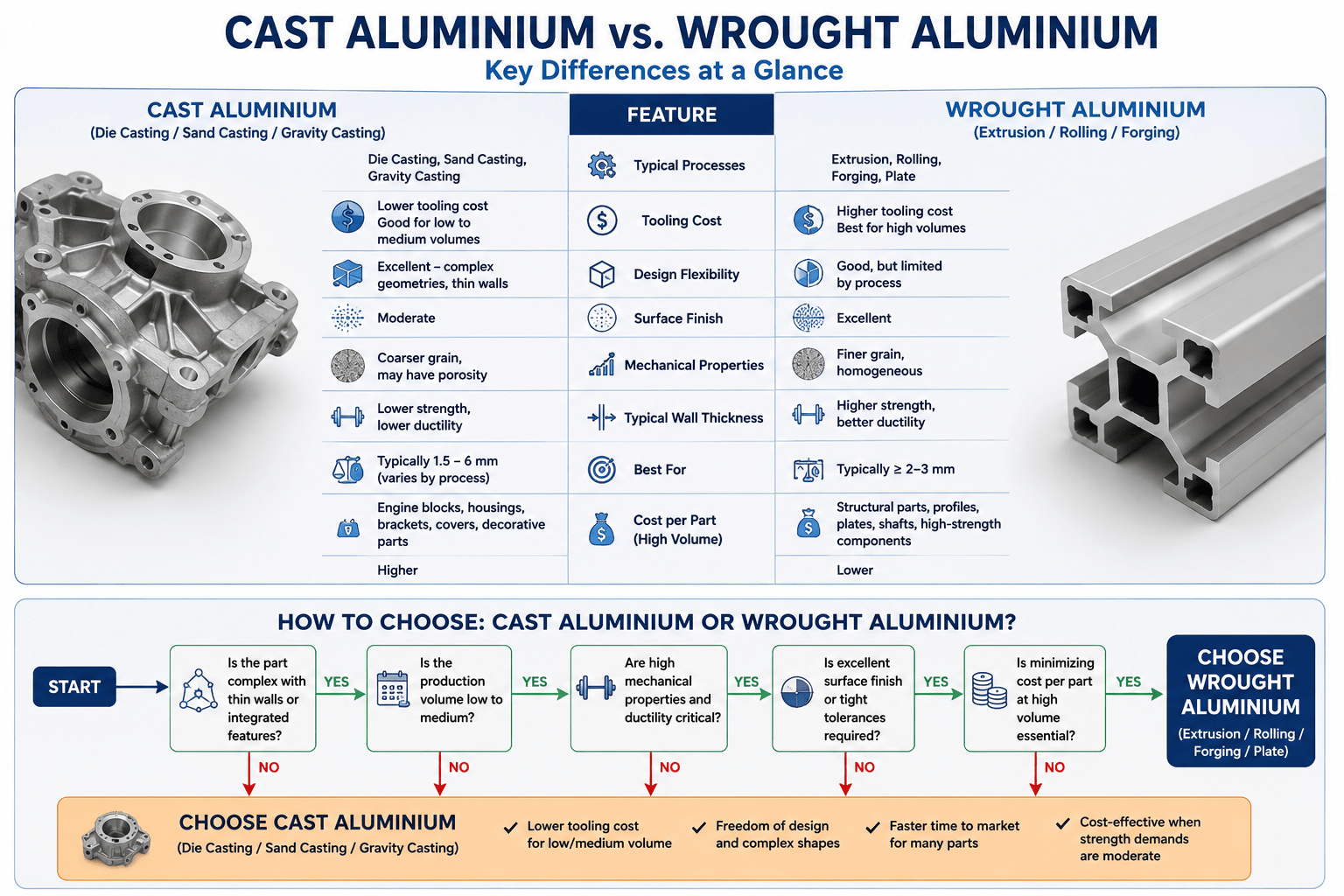
10. A simple decision guide
Wrought aluminium is often the better choice when:
- the geometry is relatively simple;
- the component can be extruded, rolled or forged;
- high and predictable mechanical properties are important;
- the production volume is high;
- welding and machining are acceptable;
- long constant sections are required.
Cast aluminium is often the better choice when:
- the geometry is complex;
- many features can be integrated into one component;
- ribs and bosses are required;
- machining and assembly can be reduced;
- the component has a complex three-dimensional shape;
- production quantities justify casting tooling.
Conclusion
There is no universal winner between cast and wrought aluminium.
Wrought aluminium offers predictable properties, efficient production of simple shapes and excellent performance in many structural applications.
Cast aluminium offers much greater geometrical freedom and can produce complex components with fewer parts and less assembly.
The best choice should therefore be based on the complete engineering problem:
material + geometry + manufacturing process + loading + fatigue + inspection + cost.
The most important question is not:
“Which aluminium alloy is stronger?”
It is:
“Which manufacturing process can produce the required component with the required performance and reliability?”
That is the real starting point for aluminium component design.
References
- European Commission JRC — Eurocode 9: Design of aluminium structures. (eurocodes.jrc.ec.europa.eu)
- EN 1706:2020+A1:2021 — Aluminium and aluminium alloys — Castings — Chemical composition and mechanical properties. (Svenska institutet för standarder, SIS)
- EN 755-2 — Aluminium and aluminium alloys — Extruded rod/bar, tube and profiles — Mechanical properties.
- European Commission JRC — Second-generation EN 1999 Eurocode 9. (JRC Publications)