Aluminium Casting Alloys: How to Choose the Right Alloy
Choosing an aluminium casting alloy is not simply a question of finding the alloy with the highest tensile strength.
The right alloy depends on the complete engineering problem:
part geometry + casting process + required strength + ductility + temperature + corrosion + machining + heat treatment + cost.
For this reason, the best casting alloy for a simple bracket may be completely different from the best alloy for a large machine housing, a hydraulic component or a safety-critical structural casting.
1. Start with the Casting Process
Before choosing the alloy, the engineer should know how the part will be cast.
Common aluminium casting processes include:
- sand casting;
- permanent mould casting;
- low-pressure casting;
- high-pressure die casting;
- investment casting.
The casting process has a major influence on the final properties.
EN 1706 specifies aluminium casting alloys, their chemical composition and mechanical properties for separately cast test pieces. The standard provides different requirements depending on the casting process and temper.
This means that an alloy should not be selected independently of the casting technology.
A composition that works very well in permanent mould casting may not be the best choice for high-pressure die casting or a large sand casting.
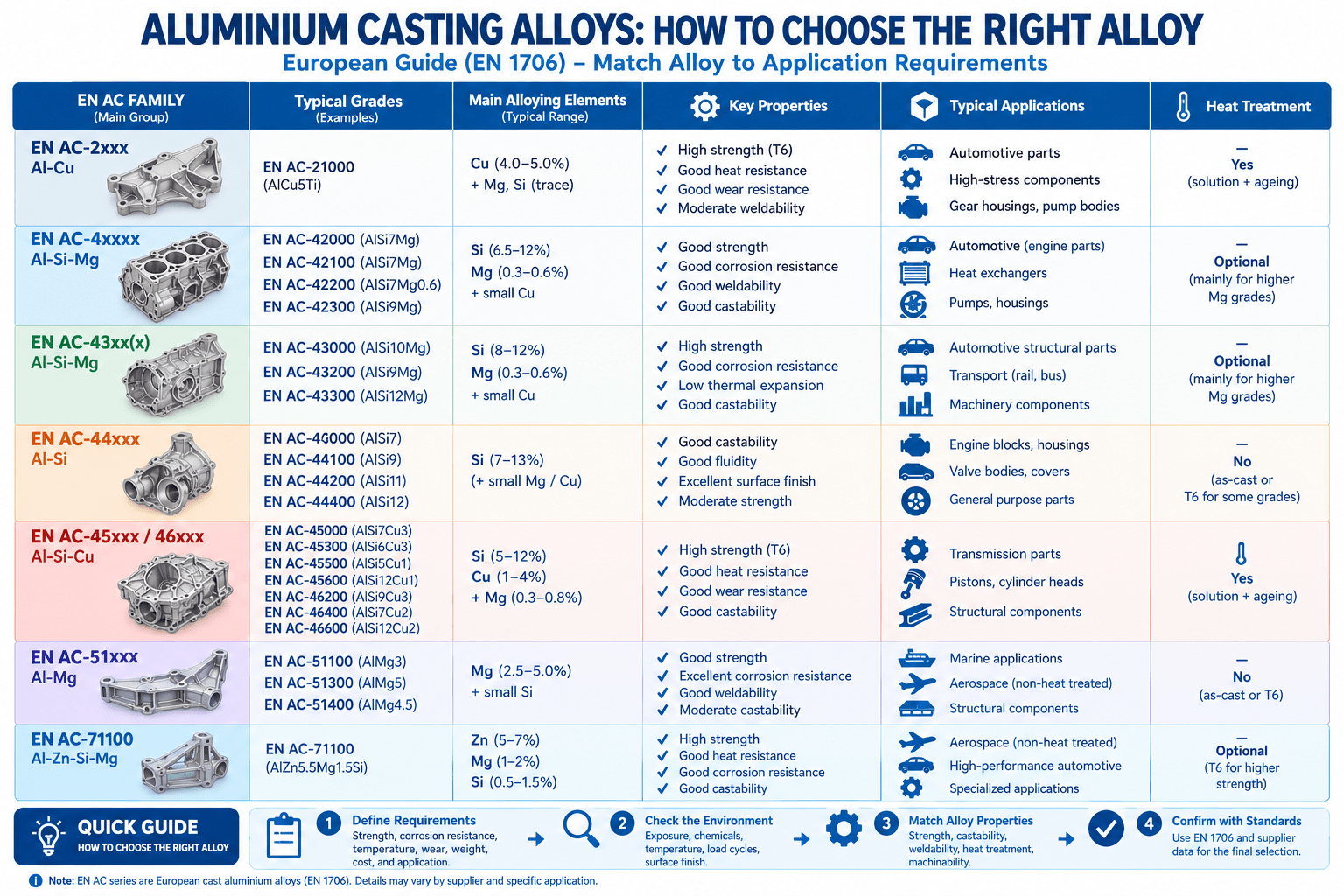
2. Al-Si Alloys Are the Main Casting Family
Aluminium-silicon alloys are the most widely used aluminium casting alloys.
Silicon improves:
- fluidity;
- castability;
- resistance to hot tearing;
- feeding behaviour;
- dimensional stability.
This makes Al-Si alloys suitable for many industrial casting applications.
The silicon content can vary significantly. Hypoeutectic alloys are common for general engineering castings, while near-eutectic and hypereutectic alloys are used where different combinations of castability, wear resistance or temperature performance are required.
For many engineering components, the Al-Si family is the natural starting point for alloy selection.
3. Al-Si-Mg Alloys: A Good Choice for Structural Castings
When strength and ductility are important, Al-Si-Mg alloys are often among the first choices.
Typical European alloys include:
- EN AC-42000;
- EN AC-42100;
- EN AC-42200;
- EN AC-43000;
- EN AC-43300.
EN AC-42100 is an Al-Si7Mg0.3 alloy, while EN AC-42200 is an Al-Si7Mg0.6 alloy.
Magnesium allows these alloys to respond to precipitation hardening. With an appropriate heat treatment, such as T6, the mechanical properties can be significantly increased.
This alloy family is therefore widely used for:
- structural castings;
- brackets;
- housings;
- suspension components;
- machine components;
- wheels and other safety-related parts.
For a mechanically loaded casting where ductility is important, an Al-Si-Mg alloy is often a very good starting point.
4. Why T6 Can Make a Big Difference
The alloy designation alone does not tell the complete story.
The temper is also important.
For heat-treatable casting alloys, T6 normally involves solution heat treatment, quenching and artificial ageing.
The result can be a substantial increase in yield strength and tensile strength.
For example, EN 1706 gives minimum properties for separately cast test pieces that depend on both the alloy and the temper.
For EN AC-42100, the minimum properties for a chill-cast T6 test piece are higher than for the corresponding T64 condition.
This demonstrates an important engineering principle:
Do not compare casting alloys without comparing their heat-treatment condition.
However, T6 is not automatically the best solution for every component. Heat treatment can introduce distortion, dimensional changes and additional production cost.
5. Al-Si-Cu Alloys: Strength, Machining and Temperature
Copper changes the behaviour of aluminium casting alloys significantly.
Al-Si-Cu alloys are widely used when the component requires:
- higher strength;
- good machinability;
- wear resistance;
- better performance at elevated temperature.
Examples include alloys in the EN AC-45xxx and EN AC-46xxx groups.
These alloys are common in engine and powertrain applications, where temperature and wear can be more important than maximum ductility.
However, copper usually reduces corrosion resistance compared with many Al-Si-Mg alloys.
Therefore, adding copper simply to obtain higher strength is not always a good engineering decision.
The service environment must also be considered.
6. Al-Si Alloys Without Magnesium
Some aluminium castings do not require high mechanical strength or heat treatment.
For these applications, simpler Al-Si alloys can be attractive.
Examples include:
- EN AC-44000;
- EN AC-44100;
- EN AC-44200;
- EN AC-44400.
These alloys can provide good castability and useful ductility at relatively low cost.
They are often suitable for:
- covers;
- housings;
- low-stressed machine parts;
- general engineering components;
- parts where casting performance is more important than maximum strength.
The key advantage is often not strength but reliable and economical casting.
7. AlMg Alloys: When Corrosion Resistance Matters
Aluminium-magnesium casting alloys form another important group.
Examples include:
- EN AC-51100;
- EN AC-51300;
- EN AC-51400.
Al-Mg alloys can provide good corrosion resistance and useful ductility.
They can be attractive for components exposed to aggressive environments or where welding and corrosion performance are important.
The designer must nevertheless consider the required casting process and mechanical properties before selecting this family.
8. Do Not Ignore Iron
Iron is one of the most important impurities in aluminium casting.
It can form intermetallic phases that reduce ductility and can affect fatigue performance.
This becomes especially important when using recycled aluminium.
The alloy may have an acceptable average chemical composition but still produce undesirable microstructural features if impurity levels and melt quality are not controlled.
For critical castings, chemical analysis should therefore be combined with proper melt treatment and process control.
EN 1706 defines limits for alloying elements and impurities and specifies chemical analysis requirements for aluminium castings.
9. Strength Is Not the Only Material Property
A good alloy selection should consider at least five groups of properties.
Mechanical Properties
- yield strength;
- tensile strength;
- elongation;
- fatigue strength;
- hardness.
Manufacturing Properties
- fluidity;
- feeding behaviour;
- hot tearing resistance;
- tendency to porosity;
- heat-treatment response;
- machinability.
Service Properties
- corrosion resistance;
- wear resistance;
- temperature resistance;
- dimensional stability.
Quality Requirements
- allowable porosity;
- inclusion limits;
- surface quality;
- non-destructive testing.
Economic Factors
- alloy cost;
- melt losses;
- heat-treatment cost;
- machining cost;
- scrap and recycling.
The best alloy is the one that provides the required combination of properties at an acceptable total cost.
10. A Practical Selection Guide
Choose Al-Si-Mg When:
- structural strength is important;
- good ductility is required;
- T6 heat treatment is acceptable;
- the part is moderately to highly loaded.
Choose Al-Si-Cu When:
- higher strength is required;
- machining is important;
- elevated-temperature performance matters;
- wear resistance is important.
Choose Simpler Al-Si Alloys When:
- casting performance is the main priority;
- loads are moderate;
- heat treatment is not required;
- low cost is important.
Consider Al-Mg When:
- corrosion resistance is important;
- ductility is important;
- the service environment is demanding.
These are general guidelines, not universal rules. The exact alloy should always be selected together with the casting process and required properties.
11. Design and Alloy Selection Must Be Connected
The alloy cannot compensate for poor casting design.
A high-strength alloy will not solve problems caused by:
- very thick sections;
- poor feeding;
- sharp corners;
- poor metal flow;
- isolated hot spots;
- excessive turbulence;
- inadequate heat treatment.
For example, a well-designed EN AC-42100-T6 casting with controlled solidification can be a better engineering solution than a stronger alloy cast with poor process control.
This is why casting simulation, feeding analysis and process control can be as important as alloy selection.
12. What About Eurocode 9?
For European structural applications, Eurocode 9 provides the framework for the design of aluminium structures.
However, its treatment of casting alloys is more limited than its treatment of wrought aluminium alloys.
Therefore, when a casting is used as a load-bearing structural component, the engineer should consider not only the nominal alloy properties but also:
- casting process;
- material condition;
- casting quality;
- defect limits;
- inspection;
- actual stress distribution.
EN 1706 is an important material standard, but the mechanical properties listed for separately cast test pieces should not automatically be assumed to represent every location in a large casting.
Conclusion
There is no single “best” aluminium casting alloy.
Al-Si alloys provide the basic foundation for most casting applications because of their excellent castability.
Al-Si-Mg alloys are attractive when strength and ductility are required.
Al-Si-Cu alloys are useful when strength, machinability, wear or elevated-temperature performance are important.
Al-Mg alloys can be attractive when corrosion resistance and ductility are priorities.
The final choice should always be made together with the casting process and heat-treatment condition.
The most useful question is not:
Which alloy has the highest strength?
It is:
Which alloy can reliably produce the required properties in this particular casting process and this particular component?
That is the correct starting point for aluminium casting alloy selection.