Design of Cast Aluminium Parts: General Engineering Principles
Cast aluminium is widely used for housings, brackets, covers, frames, machine parts, hydraulic components and many other engineering products. Casting allows engineers to produce complex shapes with ribs, bosses, holes and local reinforcement in one part.
However, a good cast aluminium part cannot be designed simply as a machined block made from aluminium. The casting process strongly affects the geometry, material properties and reliability of the final component.
The basic rule is simple:
The part should be designed together with the casting process.
1. Choose the alloy and casting process first
The first design decision is not only the aluminium alloy. The casting process is equally important.
Common processes include:
- sand casting;
- permanent mould or gravity die casting;
- low-pressure casting;
- high-pressure die casting;
- investment casting.
EN 1706 defines aluminium casting alloys, chemical composition and minimum mechanical properties for different casting processes and tempers. The standard also requires the complete casting designation to identify the alloy, casting process and heat-treatment condition.
For example, an engineer should not specify only:
EN AC-42000 T6
A complete specification should identify the casting process as well. EN 1706 gives examples such as EN 1706 AC-42000-K-T6, where K identifies chill or permanent-mould casting and T6 identifies the heat-treatment condition.
The casting process determines achievable wall thickness, surface quality, dimensional accuracy, porosity level and mechanical properties.
2. Avoid large differences in wall thickness
One of the most important principles of cast aluminium design is to avoid sudden changes in section thickness.
A thick area cools and solidifies later than a thin area. This can produce:
- shrinkage porosity;
- internal cavities;
- residual stresses;
- distortion;
- hot cracking.
A better design uses a relatively uniform wall thickness and adds strength with ribs instead of simply making the wall much thicker.
For example, instead of a 20 mm thick wall, a designer may use a 6–8 mm wall with properly designed external ribs. This can reduce weight and improve solidification.
The transition between sections should also be gradual. Sharp changes in thickness are potential locations for stress concentration and casting defects.
3. Use ribs instead of heavy sections
Ribs are one of the most useful tools in cast aluminium design.
A well-designed rib can increase bending stiffness without creating a large mass of metal. This is particularly important for aluminium because excessive section thickness can create serious feeding and shrinkage problems.
Ribs should normally have:
- reasonable thickness;
- gradual transitions;
- proper connection to the main wall;
- suitable draft for mould removal;
- generous fillets at their bases.
The designer should remember that a rib is not only a structural feature. It is also part of the solidification system.
4. Use generous radii
Sharp internal corners are undesirable in castings.
A sharp corner creates a local stress concentration and also makes metal flow and solidification more difficult. Internal fillets should therefore be used wherever possible.
The radius should be selected according to:
- wall thickness;
- alloy;
- casting process;
- loading conditions;
- machining requirements.
External corners can also require appropriate radii because they affect mould filling, tool life and dimensional accuracy.
A smooth transition between walls is normally better than a sharp intersection.
5. Design for metal flow and solidification
A casting designer must think about how liquid aluminium will enter the mould and how the part will solidify.
The ideal design allows the metal to fill the cavity without creating excessive turbulence or isolated hot spots.
The feeding system must provide liquid metal to areas that solidify last. Thick bosses, heavy ribs and large intersections can therefore become critical regions.
For complex components, casting simulation can be very useful. Modern simulation software can predict:
- filling time;
- temperature distribution;
- solidification;
- shrinkage;
- porosity risk;
- hot spots;
- possible defects.
This allows the casting design and gating system to be developed together rather than correcting defects after production starts.
6. Consider machining from the beginning
Many engineering castings require machining after casting.
Machined surfaces should therefore be clearly defined during the design stage.
The designer should specify:
- machining allowances;
- datum surfaces;
- critical dimensions;
- functional holes;
- flatness requirements;
- position tolerances.
ISO 8062-3:2023 provides general dimensional and geometrical tolerances and machining allowance grades for castings produced from different metals and alloys. It covers dimensions and geometrical characteristics such as straightness, flatness, roundness, parallelism, perpendicularity, symmetry and coaxiality.
It is usually better to machine only the surfaces that are functionally necessary. Excessive machining increases cost and can expose internal casting defects.
7. Do not assume that a separately cast test bar represents the whole part
This is especially important for structural aluminium castings.
EN 1706 specifies minimum mechanical properties for separately cast test pieces. The properties depend on alloy, casting process and temper. For some casting processes and tempers, properties must be agreed between the supplier and purchaser.
The actual component can have different cooling rates and different levels of porosity in different areas.
Therefore, for highly loaded castings, the engineer should consider:
- where the critical stresses occur;
- where defects are most likely;
- how test specimens represent the component;
- whether additional non-destructive testing is required.
This is one of the fundamental differences between designing a casting and designing a rolled or extruded aluminium component.
8. Use Eurocode 9 carefully
EN 1999, Eurocode 9, provides rules for the design of aluminium structures. It covers resistance, serviceability, durability and fire resistance.
However, its application to castings is limited. The Eurocode material documentation explains that EN 1999-1-1 is not generally applicable to castings and that special provisions and quality-control requirements are needed when castings are used as load-bearing elements.
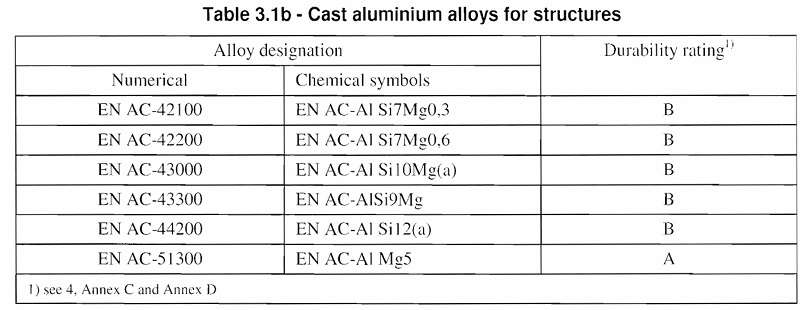
This means that the engineer should not simply take the tensile strength listed for a casting alloy and use it as the design strength of every region of a large casting.
For important structural castings, material properties, casting quality and inspection requirements should be defined together with the design assumptions.
9. Design for inspection
A good casting design should also be easy to inspect.
Critical areas may require:
- visual inspection;
- dimensional inspection;
- radiographic testing;
- ultrasonic testing;
- penetrant testing;
- hardness testing;
- mechanical testing.
The inspection method should be selected according to the type of defect and the function of the component.
For example, internal shrinkage porosity cannot normally be assessed reliably by visual inspection. A critical internal region may therefore require radiographic or other suitable non-destructive testing.
10. The best casting is not the strongest-looking casting
A common mistake is to add more metal when a casting appears insufficiently strong.
This is often the wrong approach.
A better solution is usually:
better load paths + uniform walls + ribs + generous radii + controlled solidification + appropriate inspection.
A good cast aluminium component is therefore the result of cooperation between the mechanical designer, foundry engineer, metallurgist and quality engineer.
The most successful design is not simply the easiest shape to manufacture. It is the shape that provides the required strength and stiffness while controlling weight, casting defects, machining cost and inspection requirements.
Conclusion
Designing cast aluminium parts requires a different approach from designing parts made from extruded, rolled or forged aluminium.
The engineer must consider the alloy, casting process, wall thickness, ribs, radii, metal flow, solidification, machining and inspection from the beginning.
For European applications, EN 1706 is an important reference for aluminium casting alloys and their properties, while EN 1999 provides the structural design framework for aluminium where its rules are applicable. Dimensional and geometrical requirements can be specified using the ISO 8062 series.
The key principle is:
Design the casting, not just the part.
References
- European Commission Joint Research Centre — Eurocode 9: Design of aluminium structures.
- EN 1706:2020+A1:2021 — Aluminium and aluminium alloys — Castings — Chemical composition and mechanical properties.
- ISO 8062-3:2023 — Geometrical product specifications — Dimensional and geometrical tolerances and machining allowances for castings.
- European Commission JRC — Background information on the application of Eurocode 9 to castings.