Aluminum vs Magnesium: Properties, Alloys, and Manufacturing
🏭 Core Properties: Aluminum vs Magnesium
To understand why these metals behave so differently in the workshop, we must look at their fundamental physics and atomic structures.
Weight & Density Ratio Comparison
1. Density and Weight Saving
The most famous difference is weight. Magnesium is the lightest structural metal on Earth, boasting a low density of just 1.74 g/cm³. In contrast, aluminum has a density of 2.70 g/cm³. This means magnesium is roughly 33% to 35% lighter than aluminum. For aerospace and automotive engineering, this density gap is the primary reason to justify using magnesium.
2. Crystal Lattice Structure
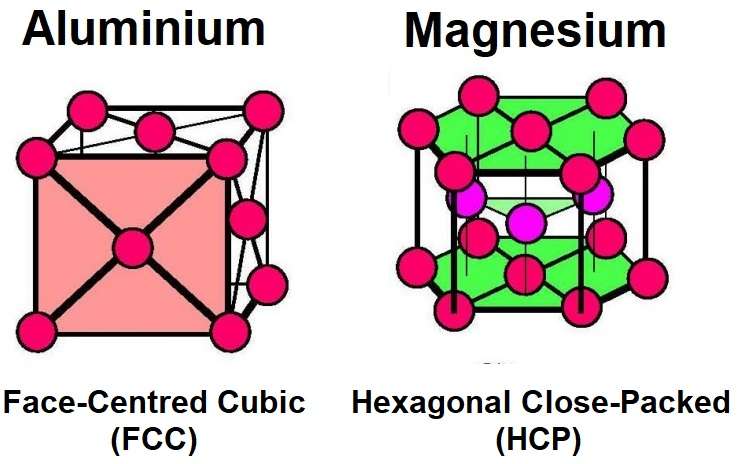
The mechanical limits of both metals are dictated by their atomic geometry:
- Aluminum features a Face-Centered Cubic (FCC) crystal lattice. This highly symmetrical structure allows atomic planes to slide past one another easily. As a result, aluminum is naturally ductile, flexible, and resistant to cracking when bent at room temperature.
- Magnesium features a Hexagonal Close-Packed (HCP) crystal lattice. This structure has fewer slip systems available at room temperature, making raw magnesium brittle and prone to cracking under sudden cold deformation.
3. Absolute Strength vs. Specific Strength
When comparing raw tensile strength, aluminum wins comfortably. Standard aluminum alloys easily exceed a yield strength of 270 MPa, while common magnesium alloys sit around 150 to 200 MPa.
However, if you calculate specific strength (strength-to-weight ratio), magnesium catches up. For components where weight is fixed but high strength is required, a magnesium part can be designed slightly thicker while remaining lighter than its aluminum counterpart.
4. Corrosion Resistance
Aluminum forms a natural, self-healing aluminum oxide (Al₂O₃) layer when exposed to oxygen. This barrier provides excellent resistance against atmospheric corrosion and moisture. Magnesium is highly reactive. Its natural oxide layer is porous and breaks down quickly in humid or salty conditions. Therefore, magnesium components almost always require specialized surface coatings, such as anodizing or powder coating, to survive.
5. Damping Capacity
Magnesium has an exceptional ability to absorb mechanical vibrations and impacts. Its internal atomic structure dampens energy, turning kinetic vibrations into heat. Aluminum passes vibrations right through, making magnesium far superior for housing rotating machinery or acoustic devices.
🛠 Manufacturing and Processing Technologies
Working with aluminum vs magnesium requires completely different workshop strategies, machine setups, and safety protocols.
CNC Machining and Cutting
Both metals are excellent for precision cutting, but they require distinct precautions based on their properties:
- Tool Wear: Magnesium is highly machinable, requiring lower cutting pressures than aluminum. This results in minimal tool wear and faster cycle times.
- The Fire Hazard: Fine magnesium chips and dust are highly flammable. If the temperature at the cutting edge reaches the ignition point, magnesium can burn violently. Machining requires specialized non-reactive coolants, sharp tools to avoid friction, and strict dust control. Aluminum machining produces no such fire hazards.
Die Casting
In high-volume manufacturing, both materials are heavily utilized in die casting:
- Wall Thickness: Magnesium features exceptional fluidity when molten. It can fill complex molds with extremely thin walls—down to 0.5 mm. Aluminum requires thicker walls to ensure complete mold filling without cold shuts.
- Die Longevity: Molten magnesium does not attack steel casting dies the way molten aluminum does. Consequently, a casting die used for magnesium lasts significantly longer, reducing long-term tooling costs.
Extrusion and Hot Forming
Because of its HCP lattice, magnesium cannot be easily extruded or formed at room temperature without cracking. It must be heated to 250°C–450°C to open up additional atomic slip planes. Aluminum extrudes seamlessly at standard temperatures and can be bent into complex architectural profiles with ease.
🧬 Understanding the Global Alloy Systems
Neither metal is typically used in its pure form. They are blended with other elements to enhance their properties. Standard commercial classifications follow international industry standards, such as the ASTM system.
| Alloy Base | Main Series / Class | Key Properties & Industrial Uses |
|---|---|---|
| Aluminum (Al) | 2xxx Series (Al-Cu) | High strength, heat-treatable. Backbone of commercial aircraft fuselages. |
| Aluminum (Al) | 5xxx Series (Al-Mg) | Non-heat-treatable. Superb welding capabilities and marine corrosion resistance. |
| Aluminum (Al) | 6xxx Series (Al-Mg-Si) | Highly versatile, easily extruded. Used heavily in bicycle frames and architectural structural profiles. |
| Magnesium (Mg) | AZ Series (Mg-Al-Zn) | Most common casting alloys. Aluminum boosts strength, zinc improves fluid castability. |
| Magnesium (Mg) | AM Series (Mg-Al-Mn) | Excellent ductility and impact absorption. Used heavily in automotive safety crash parts. |
| Magnesium (Mg) | WE Series (Mg-RE-Zr) | Advanced Rare Earth alloys. Keeps structural integrity and mechanical strength up to 300°C. |
1. Key Aluminum Alloy Groups
- 2xxx Series (Al-Cu / e.g., 2024): Legated primarily with copper, these alloys are heat-treatable and achieve mechanical strength comparable to structural steel. They are critical for structural aircraft components but offer lower raw resistance to harsh chemicals or moisture.
- 5xxx Series (Al-Mg / e.g., 5052, 5083): These utilize magnesium as the primary alloying element. They cannot be heat-treated but provide spectacular welding traits and survive harsh marine or chemical environments without degrading.
- 6xxx Series (Al-Mg-Si / e.g., 6061, 6063): Combining magnesium and silicon, these are the most versatile architectural alloys. They extrude beautifully and offer a phenomenal commercial balance of strength, weight, and low production cost.
2. Key Magnesium Alloy Groups
Magnesium alloys use a standard two-letter prefix indicating the primary alloying elements (e.g., A for Aluminum, Z for Zinc), followed by rounded weight percentages.
- AZ Series (Mg-Al-Zn / e.g., AZ91, AZ31): The most widely used commercial magnesium alloys globally. Aluminum increases raw hardness and strength, while zinc improves castability. AZ91D is the definitive choice for high-pressure industrial die casting.
- AM Series (Mg-Al-Mn / e.g., AM60): These focus entirely on maximizing ductility and impact resistance. The addition of manganese also helps chemically trap iron impurities, improving basic saltwater corrosion resistance.
- WE Series (Mg-RE-Zr / e.g., WE43): This specialized group uses Rare Earth (RE) elements and zirconium. They are explicitly designed to maintain their mechanical strength at high operating temperatures up to 300°C where standard magnesium configurations melt or degrade.
🚀 Industrial Applications: Who Uses What?
The physical properties and manufacturing traits of aluminum vs magnesium naturally divide them into clear market niches.
Automotive Engineering
Weight reduction directly correlates to fuel efficiency and electric vehicle (EV) battery range. The lighter the vehicle, the less power it needs to move forward.
- Aluminum: Dominates structural car body frames, exterior doors, hoods, and large heat exchangers. It provides the rigid skeleton required to pass crash safety standards.
- Magnesium: Replaces aluminum in specific components where vibration isolation and low mass matter most. Typical applications include steering wheel cores, seat frames, dashboard support beams, and transmission housings.
Aerospace and Aviation
Every single gram counts when maintaining lift in the sky.
- Aluminum: Remains the primary commercial structural skin and internal wing ribbing material because of its highly predictable fatigue life and standard, easy field repair profile.
- Magnesium: Finds its niche in military aviation, high-performance helicopter rotor gearboxes, and lightweight aircraft seat frames to drastically drop structural weight.
Portable Consumer Electronics
Consumer electronics must be incredibly light to carry but strong enough to withstand daily accidental drops.
- Aluminum: Is widely used for mid-range laptop chassis and phone frames via simple, affordable extrusion or CNC milling.
- Magnesium: Often cast or forged to create the ultra-lightweight, premium shells of business laptops, professional DSLR camera bodies, and drone chassis where every fraction of an ounce matters.
🏁 Summary: How to Choose Your Metal
To pick the correct material for your next mechanical layout or design cycle, use this simple technical checklist:
- Choose Aluminum if: Your component needs high absolute bending stiffness, will be exposed to rugged outdoor environments without complex protective coatings, requires standard welding, or operates under tight budget constraints.
- Choose Magnesium if: Extreme weight reduction is the single highest priority of the project, you are designing complex, thin-walled die-cast shapes, or your component needs to isolate heavy mechanical vibrations from rotating machinery.