Not only the alloy, but also the temper
An another usuful post from Linkedin.
Author – H G Shripad – https://easyaluminium.com/
Not only the alloy, but also the temper
Most people know the alloy. Very few know the temper.
One letter completely changes all
Sometimes customers ask: “Can you supply this profile in T5 instead of T6?”
At first, it looked like a small change.
But that one letter completely changes how the aluminium behaves.
- Strength
- Hardness
- Formability
- Machinability
- Even the final application.
That’s why understanding temper is just as important as understanding the alloy itself.
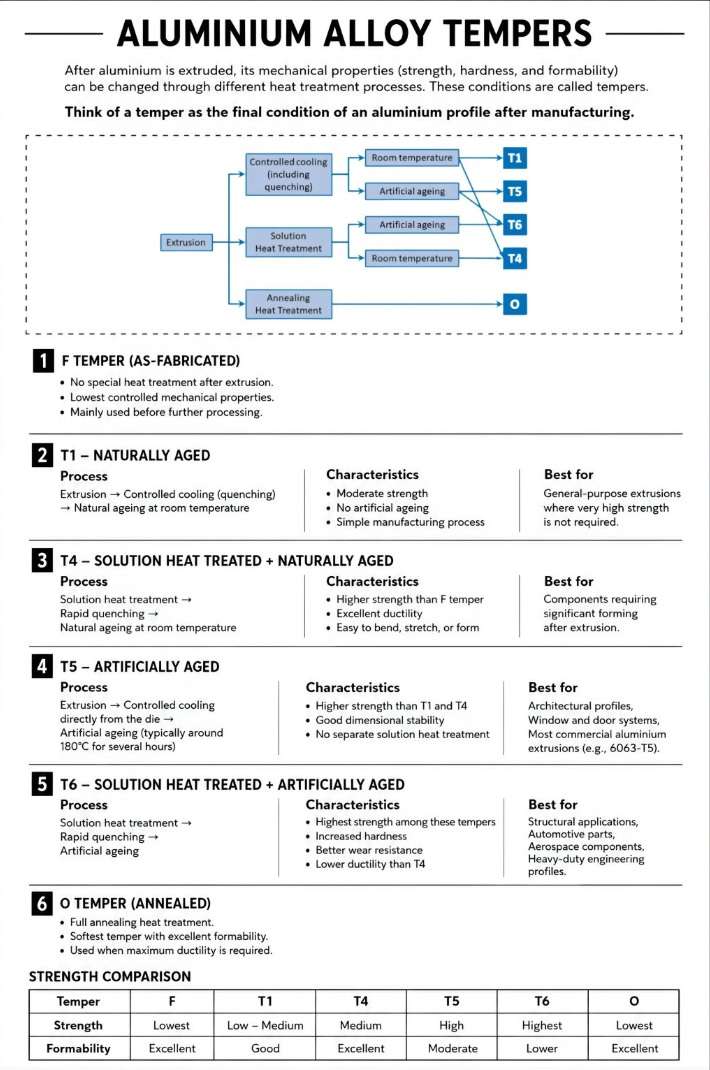
A simple overview
F Temper
As-fabricated condition with no special heat treatment.
Mainly used before further processing.
T1 Temper
Naturally aged after extrusion.
Good for general-purpose applications where moderate strength is enough.
T4 Temper
Solution heat treated and naturally aged.
Offers excellent formability, making it suitable for bending and forming operations.
T5 Temper
Artificially aged directly after extrusion.
Provides higher strength and dimensional stability.
One of the most common tempers for architectural aluminium profiles.
T6 Temper
Solution heat treated and artificially aged.
Highest strength among these tempers.
Preferred for structural, automotive and heavy engineering applications.
O Temper
Fully annealed.
Softest condition with maximum ductility and formability.
A simple way to remember
Strength:
F 👉T1 👉 T4 👉 T5 👉 T6
Formability:
T6 👉 T5 👉 T1 👉 T4 👉 O
Choosing the wrong temper can lead to:
• Cracks during bending
• Insufficient strength
• Poor machining performance
• Premature product failure
The alloy tells you what the material is. The temper tells you how the material will perform.
Follow H G Shripad for practical aluminium extrusion knowledge.