Nitriding Aluminum Extrusion Dies: Gas vs. Plasma
Nitriding is a special heat treatment that makes aluminum extrusion dies last much longer. It infuses nitrogen into the surface of the steel, creating an incredibly hard outer layer that stops heavy wear and tear.
Without this treatment, hot aluminum would quickly destroy the costly steel tools under extreme pressure.
Why Do Extrusion Dies Need Nitriding?
During the aluminum extrusion process, factories push hot metal through a steel die to make shapes. This process creates severe conditions:
- Extreme Heat: Dies operate at temperatures over 375 °C up to 570 °C.
- High Pressure: The machinery applies massive pressure to push the metal through.
- Friction and Friction Wear: Moving aluminum grips the steel surface and rubs it away.
According to information shared by Rubig: “The optimised surface minimises material adhesion, enhancing process stability and allowing consistently high exit speeds.”
Main Benefits of Nitriding
Using a nitrided die in your production line offers key financial and technical benefits:
- Longer Die Life: This process can easily double the lifespan of your steel tooling.
- Less Aluminum Sticking: It stops hot aluminum from welding onto the steel bearing surface.
- Better Product Quality: The die keeps its exact shape longer, so your extruded profiles look smooth and perfect.
- Lower Costs: Fewer tool changes mean less factory downtime and lower tool repair costs.
Common Types of Nitriding
There are two major methods used to treat aluminum extrusion dies today:
| Feature | Gas Nitriding | Plasma (Ion) Nitriding |
|---|---|---|
| How it Works | Uses ammonia gas in a heated furnace. | Uses electrical plasma in a vacuum chamber. |
| Precision | Good, but builds a brittle “white layer”. | Very high, allowing perfect control over the layers. |
| Environment | Needs exhaust burners to treat waste gas. | Environmentally friendly with no toxic emissions. |
| Cost | Cheaper setup costs. | Higher machine cost but lower daily energy use. |
Gas Nitriding Parameters for Aluminum Extrusion Dies
1. Key Process Parameters
-
- Temperature: 510°C to 530°C. Higher heat softens the steel core. Lower heat makes the process too slow.
- Time (Holding): 4 to 8 hours. This is for a new die. Total furnace time is 12 to 15 hours.
- Gas Atmosphere: Controlled Ammonia (NH₃) mixed with Nitrogen (N₂) or Hydrogen.
- Dissociation Rate (α): 20% to 30% at first for fast loading. Then 60% to 80% to avoid a brittle layer.
2. Required Layer Properties
-
- Total Case Depth: 0.10 mm to 0.25 mm (100 to 250 μ m). Deeper layers make thin die parts break easily.
- Compound (“White”) Layer: Maximum 3 to 8 μ m. A thick white layer cracks off during aluminum extrusion.
- Surface Hardness: 1000 to 1150 HV. The base steel hardness remains at 46 to 50 HRC.
3. Links to Process Diagrams and Graphs
-
- Two-Stage Cycle Graphs: See real time, temperature, and gas potential charts on ResearchGate (Nitriding of Aluminum Extrusion Die) (Fig. 1).
- Hardness Profiles: View depth-to-hardness curves and temperature effects on Thermal Processing.
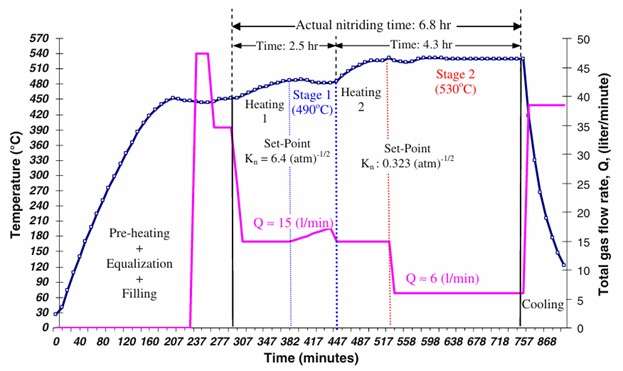 Figure 1 – In-process variations of temperature and total gas flow rate during two-stage nitriding of AISI H13 Dies
The Repeat Nitriding Cycle
Extrusion dies are unique because you must nitride them multiple times. When the die works at high temperatures, the nitrogen slowly escapes and the steel softens. Operators must stop the line, pull the die out, clean it thoroughly, and send it back to the furnace.
Experts at Vapormatt state that deep cleaning, such as wet blasting, removes all aluminum traces and prepares the steel surface for a perfect new nitriding cycle. This repeated cycle creates tough chromium nitrides inside common H13 die steel, making it stronger against cracks each time.