Iron in Aluminum: Effects, Phase Diagram, and Standards
Iron (Fe) is the most common impurity found in aluminum alloys. It gets into aluminum very easily during mining and melting. Because it is hard to remove, engineers must understand how it changes the metal. In some cases, iron is a harmful pollutant that ruins the quality of the metal. In other cases, factory workers add it on purpose to help with manufacturing. This article explains the good effects, bad effects, phase diagrams, and official limits of iron in aluminum using simple language.
The Pros and Cons of Iron in Aluminum Alloys
Iron behaves differently depending on the type of aluminum alloy. It can either be a helpful addition or a dangerous defect.
The Disadvantages (The Bad Effects)
- Loss of Ductility: Iron creates very brittle particles inside the aluminum matrix. These particles act like tiny glass pieces. When you try to bend or stretch the aluminum, it cracks quickly.
- Poor Corrosion Resistance: Aluminum forms a natural protective skin against rust. Iron breaks this skin. It creates tiny electric batteries on the surface (micro-galvanic cells) that speed up corrosion.
- Lower Electrical Conductivity: Pure aluminum is great for power cables. Iron disturbs the internal crystal structure of the metal, making it harder for electricity to pass through.
- Ugly Surfaces: If you anodize or polish aluminum that has too much iron, the surface will look cloudy or have dark spots.
The Advantages (The Good Effects)
- Anti-Sticking in Dies: When casting liquid aluminum into steel molds under high pressure, the hot liquid can weld itself to the mold. Adding iron stops the aluminum from sticking to the steel tools.
- Better Heat Resistance: Iron helps aluminum keep its strength at high temperatures (above 200°C to 300°C). This is very useful for engine parts.
- Higher Hardness: It increases the basic hardness of cast parts and reduces how much the metal shrinks as it cools down.
The Aluminum-Iron Phase Diagram Explained
A phase diagram is a map for metallurgists. It shows what happens to metals when they melt and cool down together at different temperatures.
The Al-Fe phase diagram shows that iron does not like to stay dissolved inside solid aluminum. Its maximum solubility is extremely small—only 0.052% Fe at 655°C. At normal room temperature, the solubility drops almost to 0%.
Because it cannot dissolve, any iron above 0.052% turns into solid chemical compounds called intermetallics. The most critical point on the diagram is the eutectic point. This happens at 655°C with 1.7% to 1.9% iron content. At this point, the liquid turns into a solid mix of aluminum and a brittle compound called the θ-phase (Al3Fe or Al13Fe4).
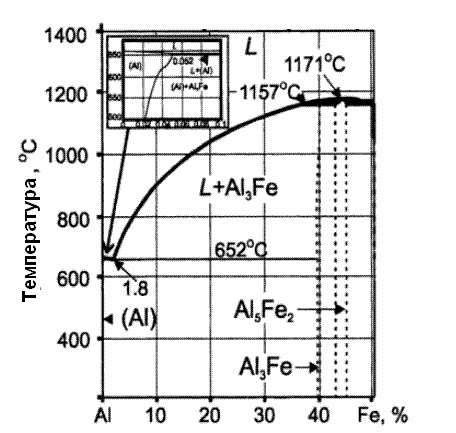 Figure – The “aluminum angle” of the aluminum-iron phase diagram [Belov at al]
Microstructure: What Iron Looks Like Inside the Metal
When you look through a microscope, iron takes three main shapes inside aluminum alloys:
- Brittle Needles (β-phase): If the alloy contains silicon and cools down slowly, iron forms long, sharp needles (Al5FeSi). These sharp needles act like microscopic cuts inside the metal. They are highly dangerous because they cause sudden breaks under pressure.
- Chinese Script Structures (α-phase): If you add manganese (Mn) or chromium (Cr), the dangerous needles change shape. They turn into rounded, branched shapes that look like Chinese handwriting symbols (Al15(Fe,Mn)3Si2). This shape is much safer because it does not have sharp points to start cracks.
- Nano-particles (Dispersoids): During heat treatment, tiny round iron particles can form deep inside the metal grains. These act like tiny anchors. They stop the metal grains from growing too big and keep the alloy strong at high temperatures.
Industrial Standards and Composition Limits
International metal organizations keep strict rules on how much iron can be inside aluminum. The two most popular standards are the international ISO 209 standard and the American ASTM E30 framework. To check these levels instantly in factories, engineers use Optical Emission Spectrometry according to ASTM E1251.
The table below shows the typical maximum limits allowed for iron across different types of global aluminum alloys (such as EN AW and AA standards):
| Aluminum Alloy Category | Common Examples | Allowed Iron Content (% by Weight) | Role of Iron |
|---|---|---|---|
| High-Purity Aluminum | EN AW-1098, AA 1199 | 0.0015% – 0.015% (Max) | Strictly a harmful impurity. |
| Technical Aluminum | EN AW-1050, AA 1350 | 0.15% – 0.40% (Max) | Accepted to give basic strength and grain control. |
| Aerospace / Wrought Alloys | AA 7075, AA 2024 | Under 0.15% (Strict) | Dangerous impurity; lowers fatigue life. |
| Architectural Extrusions | AA 6061, AA 6063 | Under 0.35% – 0.70% (Max) | Controlled limit to prevent cracking during shaping. |
| High-Pressure Die Casting | EN AC-44300, A380 | 0.60% – 1.30% (Intended) | Beneficial additive; stops sticking to molds. |
How to Reduce and Control Iron Content
If your aluminum alloy has too much iron, you cannot easily burn it out like you can with carbon in steel. Instead, metal factories use four primary industrial strategies:
1. High Shear Sedimentation (Settling)
Factories cool the liquid aluminum to a temperature just above its freezing point. They mix in elements like manganese. The iron joins with the manganese to form heavy, dense crystals. These heavy pieces sink to the bottom of the furnace by gravity. Workers can then pour out the clean aluminum from the top. Research shows this process can achieve high purification efficiency when managing scrap metal.
2. Physical Filtration
Liquid aluminum can be forced through porous ceramic foam filters (CFF). If the iron has already frozen into solid needles while the rest of the aluminum is still liquid, the filter traps these needles mechanically. This cleans the liquid metal before it is poured into molds.
3. Chemical Transformation (The Manganese Fix)
If you cannot remove the iron, you can neutralize its bad effects chemically. By adding manganese in a 1:2 ratio (half as much manganese as there is iron), the dangerous needle-like crystals are forced to grow as harmless “Chinese script” shapes. This trick keeps the metal tough and bendable without needing expensive purification equipment.
4. Thermal Transformation (Homogenization of Ingots)
Before aluminum blocks (ingots) are rolled into sheets or squeezed into architectural profiles (like windows and frames), factories heat them to very high temperatures (usually between 540°C and 580°C) for several hours. This industrial process is called homogenization.
During homogenization, the dangerous, sharp iron needles change their internal crystal structure. They break down and turn into small, rounded, safer balls. At the same time, this intense heat helps to dissolve magnesium silicide (Mg2Si) back into the aluminum matrix. Dissolving Mg2Si is crucial for structural profiles because it makes the metal soft enough to squeeze through extrusion dies smoothly, while allowing it to develop maximum strength later during final age hardening.
5. Good Housekeeping in the Foundry
- Coat Your Tools: Never let bare steel tools touch liquid aluminum. Always paint ladles, mixers, and pots with protective ceramic coatings made of boron nitride or titanium dioxide.
- Magnetic Sorting: When recycling scrap aluminum, pass all raw materials under powerful magnets to pull out steel bolts, nails, and brackets before melting.
- Dilution (Shifting the Melt): If a batch of recycled aluminum has too much iron, mix it with pure, high-quality primary aluminum ingots to dilute the iron percentage back down to a legal limit.
Conclusion
Iron in aluminum is a constant balancing act. For high-performance aircraft or ductile wires, it is a dangerous contaminant that must be kept near zero. For high-volume automotive parts made in steel molds, it is an essential ingredient that speeds up production. By tracking industrial standards like ISO 209, utilizing thermal homogenization, and using manganese modifiers, metal workers can control this common element effectively.