Evolution of Aluminum Scrap Melting Furnaces
Aluminum is one of the most recycled materials in the modern world. Melting aluminum scrap uses only about 5% of the energy needed to make primary aluminum from raw bauxite ore. Because of this massive energy saving, the technology used to melt aluminum scrap has evolved rapidly. Today, industrial furnaces must handle various types of scrap while minimizing metal loss, cutting fuel costs, and meeting strict environmental laws.
1. The History and Traditional Reverberatory Furnaces
For many decades, the standard tool for large-scale aluminum recycling was the classic stationary reverberatory furnace. The name comes from the way heat behaves inside the chamber: fuel burners mounted on the walls or roof radiate heat downward, and the heat “reverberates” (reflects) off the curved brick ceiling onto the metal bath below.
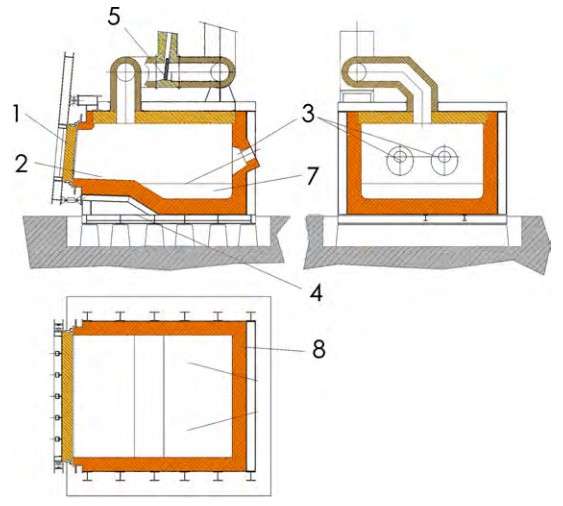
5 – pressure control damper, 7 -metal bath, 8 – refractory lining
Figure 1: A traditional stationary reverberatory furnace with an open hearth design [Schmitz].
While these traditional systems could hold massive amounts of molten metal, they had major thermodynamic drawbacks. First, the open-flame burners created a highly oxidizing atmosphere inside the chamber. When bare aluminum scrap is exposed directly to oxygen and extreme heat, it burns quickly, forming an unwanted waste byproduct called aluminum dross. In older furnaces, metal loss due to oxidation could easily reach 5% to 8% of the total charge. Furthermore, their thermal efficiency was poor, often hovering between 20% and 30%, meaning most of the heat escaped straight up the exhaust stack.
2. Modern Technological Advancements
To solve the problems of high energy consumption and metal loss, engineers introduced several key innovations over the last twenty-five years:
-
- Oxy-Fuel Burners: Traditional burners use ambient air, which contains about 78% nitrogen. This nitrogen takes up heat energy but does not help combustion. Modern systems use pure oxygen instead of air. This eliminates nitrogen gas, concentrates the flame temperature, reduces fuel use by up to 40%, and vastly lowers harmful nitrous oxide (NOx) emissions.
-
- Regenerative Burner Systems: These systems work in pairs. While one burner fires fuel into the furnace, the other acts as an exhaust port, trapping the escaping heat in a ceramic bed. After a few minutes, the cycle reverses: the cold incoming air is pushed through the hot ceramic bed, preheating the air to over 1000°C before it even touches the fuel.
-
- Electromagnetic Stirring (EMS): Liquid aluminum is highly reflective and does not conduct heat evenly from the top down. EMS devices are installed outside the furnace shell. They use magnetic fields to silently stir the molten metal bath without opening the doors. This evens out the temperature, speeds up the melting process, and stops hot spots from destroying the brick lining.
3. Advanced Furnace Designs for Scrap Processing
Aluminum scrap is no longer just clean factory leftovers. Today’s recycling streams include contaminated materials like painted beverage cans, oily automotive parts, and shredded scrap mixed with plastics. Processing these materials requires special furnace architectures.
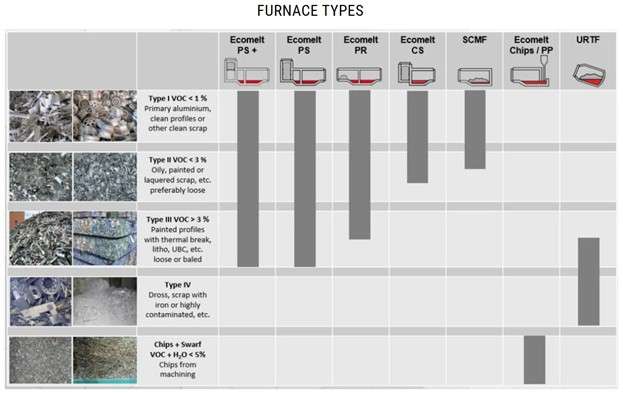
Multi-Chamber Furnaces
Multi-chamber furnaces separate the melting zone from the charging zone. The scrap is loaded into an outside pocket or a dedicated charging chamber filled with liquid metal, rather than being placed directly under an open flame. Submerged melting systems use mechanical or electromagnetic pumps to pull thin-gauge scrap underwater immediately. This stops oxygen from touching the hot scrap, reducing dross formation significantly. If the scrap has oils or paints, the heat from the main chamber is recycled to burn off these organic coatings safely in a closed system, turning the waste materials into useful fuel.
Tilting Rotary Furnaces (TRF)
For low-grade scrap, dross, and mixed waste, the Tilting Rotary Furnace is the industry preferred solution. The furnace consists of a heavy, barrel-shaped drum lined with refractory brick that rotates continuously. This rotation turns the scrap over constantly, transferring heat directly from the hot walls to the metal. Because it tilts mechanically, operators can easily pour out clean liquid aluminum from one side and dump out solid oxides from the other. TRFs can melt highly contaminated materials with minimal flux salt usage, making them incredibly flexible for modern recycling.
4. Technical Comparison of Furnace Types
The table below summarizes the key operational performance traits across the main types of aluminum recycling furnaces used in industrial smelting plants today:
| Furnace Type | Optimal Scrap Input | Thermal Efficiency | Metal Yield Rate | Energy Consumption |
|---|---|---|---|---|
| Stationary Reverberatory | Clean, heavy solid blocks | 25% – 35% | 92% – 94% | 650 – 800 kWh/tonne |
| Modern Multi-Chamber | Thin loose sheets, cans, turnings | 65% – 75% | 97% – 98.5% | 450 – 550 kWh/tonne |
| Tilting Rotary (TRF) | Dross, highly contaminated scrap | 55% – 65% | 95% – 97% | 500 – 600 kWh/tonne |
5. Conclusion and the Future of Melting
The aluminum recycling industry has moved away from simple, inefficient thermal chambers. Modern smelting facilities rely on smart, multi-chambered, or rotating systems that protect the metal from oxidation while extracting every bit of thermal energy from fuel. As automation, digital sensor arrays, and green hydrogen fuels continue to develop, aluminum recycling furnaces will become even cleaner, paving the way for a fully circular and sustainable metal economy.