Aluminum extrusion temperature control
Aluminum extrusion temperature control is the most important factor in making high-quality metal profiles. If the temperature gets too high, the metal rips and cracks. If it stays too cold, the metal gets too hard to push through the machine. This destroys the steel tooling and slows down your factory production.
For factory owners and machine operators, finding the perfect thermal balance is a daily challenge. This guide breaks down the complex science of heat management into simple, easy-to-understand steps. You will learn the exact target numbers, common production mistakes, and modern tools used to measure hot moving metal.
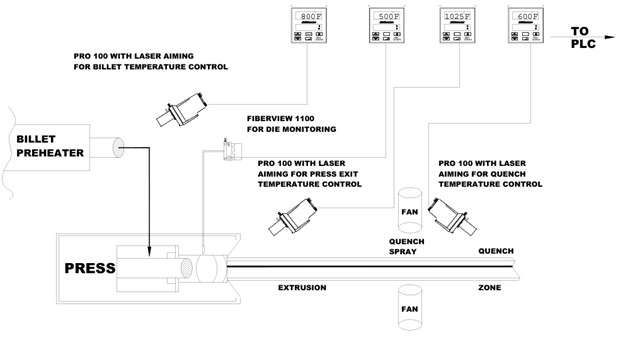
[B. Barron and T. Larrick / Thermal Management Practices For Aluminum Extrusion –
Aluminium Extrusion Technology Seminar, 2004]
What is Aluminum Extrusion and Why Does Heat Matter?
The extrusion process works like squeezing toothpaste out of a tube. A powerful hydraulic press pushes a solid round block of aluminum, called a billet, through a steel disk with a shaped hole, called a die. The metal that comes out takes the exact shape of the hole.
However, aluminum changes its physical properties dramatically when its temperature shifts by just a few degrees. To push the metal successfully, it must enter a state called plastic deformation. This means the aluminum is soft enough to change shape easily but not hot enough to melt into a liquid.
If you fail to maintain proper aluminum extrusion temperature control, you will face two major financial problems:
- Surface Defects: Profiles come out with rough skin, bubbles, or structural cracks, making them unusable scrap metal.
- Tooling Destruction: Pushing cold aluminum requires immense hydraulic pressure, which bends, cracks, and ruins expensive steel dies.
The Three Critical Temperature Control Points
To run a stable and high-speed manufacturing line, you must track and manage the heat at three specific locations on your press line. Missing even one of these points will cause the entire process to fail.
1. Billet Preheat Temperature
Before the aluminum goes anywhere near the hydraulic press, it must be heated inside a large gas or induction furnace. The general target window for most standard alloys is 400°C to 540°C (752°F to 1004°F).
If the billet is too cold, the metal will act like a hard rock. Your press will hit its maximum safety pressure limit and stop moving completely. If the billet is too hot, the metal loses all structural strength right inside the machine container, causing severe structural collapse.
2. Die Preheating Stage
The steel die must never be cold when hot aluminum hits it. Cold steel acts like a giant heat sponge. It instantly sucks the thermal energy out of the front of the aluminum billet. This creates a hard metal plug that jams the die openings.
Operators must preheat all extrusion dies in specialized ovens to a stable range of 450°C to 480°C (842°F to 896°F) before installing them into the press slide. This ensures smooth metal flow from the very first second of operation.
3. Die Exit Temperature (The Critical Metric)
The single most important number on any extrusion line is the temperature of the profile exactly as it shoots out of the die. For popular 6000-series alloys, this number must stay locked between 500°C and 575°C (932°F to 1067°F).
If the exit temperature drops below 498°C, the chemical elements inside the metal (magnesium and silicon) will not mix correctly. The finished profile will remain soft and fail basic strength tests. If it climbs too high, the metal breaks apart at the edges.
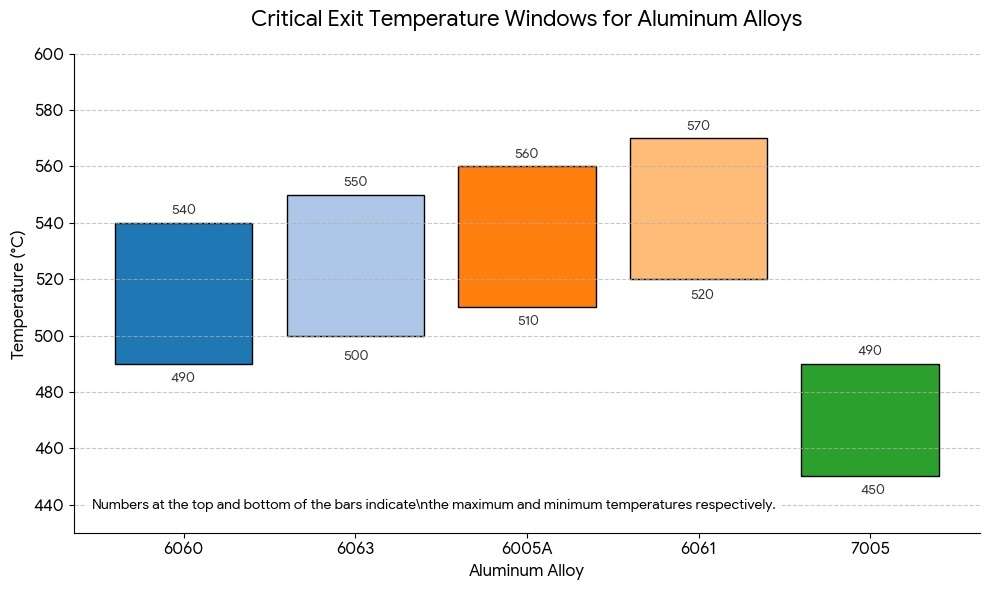
Alloy Temperature Settings Comparison Table
Different types of aluminum behave in vastly different ways. Soft alloys can be pushed out very fast, while hard, high-strength alloys require slow, careful handling. The table below outlines the ideal targets for the five most common industrial alloys:
| Alloy Type | Ideal Billet Heat | Target Exit Heat | Max Press Speed | Cooling Method Needed |
|---|---|---|---|---|
| 6060 | 460°C – 490°C | 490°C – 540°C | Very High (30-50 m/min) | Standard Air Fans |
| 6063 | 470°C – 500°C | 500°C – 550°C | High (25-40 m/min) | Forced Air Fans |
| 6005A | 480°C – 510°C | 510°C – 550°C | Medium (15-25 m/min) | Water Mist Spray |
| 6061 | 490°C – 520°C | 520°C – 570°C | Slow (8-15 m/min) | Heavy Water Quench |
| 7005 | 410°C – 440°C | 450°C – 490°C | Ultra-Slow (1-4 m/min) | Slow Air Cooling |
Why Measuring Aluminum Heat is Extremely Difficult
You cannot use standard digital thermometers or cheap infrared sensors to monitor aluminum. Aluminum acts like a mirror to thermal radiation. This physical trait creates two major measurement obstacles:
- Low and Changing Emissivity: Raw aluminum does not emit infrared heat predictably. The amount of heat it radiates changes constantly based on surface rust, scratches, roughness, and alloy ingredients.
- Physical Movement: The profile is flying out of the press at high speed. Touching it with physical wire probes will scratch the soft, hot metal and quickly snap the sensor tips.
To solve this, modern factories use specialized multi-wavelength pyrometers. Industry leaders like AMETEK Land and Williamson Infrared build advanced sensors that look at multiple light colors at once. Their internal computers automatically fix the mirror effect in real-time, giving operators an exact temperature readout.
The Physics of Taper Heating and Breakthrough Pressure
When the hydraulic press pushes the billet through the machine, it generates a massive amount of internal friction. This friction acts like an on-board heater, making the metal hotter and hotter as the cycle progresses. If you start with a uniformly heated billet, the end of the profile will always overheat and tear.
The secret to solving this issue is a technique called taper heating (or gradient heating). Advanced induction furnaces heat the front of the aluminum log hotter than the back. For example, the front might be 500°C while the rear is kept at 460°C.
The hot front allows the metal to easily overcome the initial breakthrough pressure—the huge spike in hydraulic force needed to start the metal flow. As the press runs, the cooler rear section moves forward. The cold metal absorbs the rising friction heat perfectly, ensuring the profile exit temperature stays perfectly flat from the front tip to the back tail.
Figure 1 – Advanced software links exit temperature data directly to hydraulic press speeds.Advanced Isothermal Extrusion Technology
In older factories, machine operators had to manually change the press speed using hand levers while watching old pressure gauges. This guessing game caused a massive amount of ruined scrap material.
Today, top manufacturers use a closed-loop automated system called isothermal extrusion. The computer system connects the multi-wavelength optical sensor at the die exit directly to the main hydraulic pump controllers:
- The operator inputs a target exit temperature (such as 530°C for alloy 6063).
- The press starts pushing at high speed to hit peak productivity.
- If friction heat causes the metal to hit 545°C, the computer instantly slows down the hydraulic ram speed.
- If the metal cools down too much, the system speeds up the press ram to create more friction heat.
This automated loop keeps the exit heat locked in a perfect straight line, boosting production speeds while completely eliminating thermal defects.