Why Aluminium Electrical Wiring Failed in the 1960s — and What Engineers Learned
Aluminium is one of the world’s most important electrical conductor materials. It is widely used in overhead power lines, cables and electrical distribution systems.
Yet aluminium wiring also has a bad reputation, especially in the United States.
The reason goes back to the 1960s, when aluminium wire was installed in many American homes. Some of these electrical systems later developed overheating connections and fire hazards.
But the common explanation — “aluminium wire was unsafe” — is too simple.
The real story is more interesting. It changed electrical installation practice and helped create a new generation of aluminium conductor alloys.
Why Did Homes Start Using Aluminium Wire?
Copper was the traditional material for residential electrical wiring.
During the mid-1960s, economic conditions and high copper prices encouraged American builders to use more aluminium. Aluminium was already a well-established electrical conductor, particularly in larger power circuits.
The important change was its use in small 15- and 20-ampere residential branch circuits supplying lights and receptacles.
According to the U.S. Consumer Product Safety Commission (CPSC), aluminium branch-circuit wiring was widely installed in American homes from the mid-1960s into the 1970s.
This meant that relatively small aluminium wires were now connected to large numbers of ordinary switches, receptacles and junction boxes.
That is where the problems became serious.
The Problem Was Mainly at the Connections
This is the key point in understanding the history.
The aluminium wire did not normally overheat along its entire length. The critical locations were the connections.
A connection between a conductor and a terminal must maintain low electrical resistance for many years.
If contact pressure decreases, electrical resistance can increase. When current passes through this higher resistance, additional heat is generated.
A dangerous cycle can then develop:
connection deterioration → resistance increases → heating increases → further deterioration
The CPSC investigated fires and hazardous incidents involving aluminium branch-circuit connections.
Studies performed for the CPSC found that older aluminium-wired homes were much more likely than copper-wired homes to have outlet connections reaching defined fire-hazard conditions.
Was the Aluminium AA 1350?
The aluminium used in these early conductors is commonly associated with EC aluminum, meaning Electrical Conductor aluminum.
Today, this material is known as AA 1350.
The distinction is historically important. During the early period of aluminium residential wiring, technical documents normally referred to EC aluminum, not AA 1350.
And EC/1350 was not a bad electrical conductor.
It was high-purity aluminium developed to provide excellent electrical conductivity. AA 1350 remains useful for many electrical applications today.
The problem was that high electrical conductivity alone was not enough for small building-wire connections.
Why Could the Connections Deteriorate?
Several mechanisms could work together.
Thermal Expansion
Aluminium has a relatively high coefficient of thermal expansion.
When electrical current heats a conductor, aluminium expands. When the load decreases, it cools and contracts.
A household connection may experience many thousands of these heating and cooling cycles.
If the conductor and terminal materials expand by different amounts, the mechanical conditions at the contact can gradually change.
Creep and Stress Relaxation
Aluminium can slowly deform under sustained mechanical stress.
At a screw terminal, the conductor is compressed to create good electrical contact. With time and temperature, some of this stress can relax.
The important result is that contact pressure can decrease.
Lower contact pressure can increase electrical resistance and therefore produce additional heating.
Surface Oxide
Aluminium naturally develops a thin aluminium oxide layer.
This oxide protects the metal against corrosion, but aluminium oxide is a poor electrical conductor.
A properly designed electrical connection can manage this oxide layer. However, if mechanical contact deteriorates, the oxide can become another factor affecting contact resistance.
Terminal Design and Installation
The conductor was only one part of the system.
The screw, terminal material, contact geometry, tightening force and installation method were also important.
This led to an important engineering conclusion:
A reliable electrical connection must be designed as a complete system.
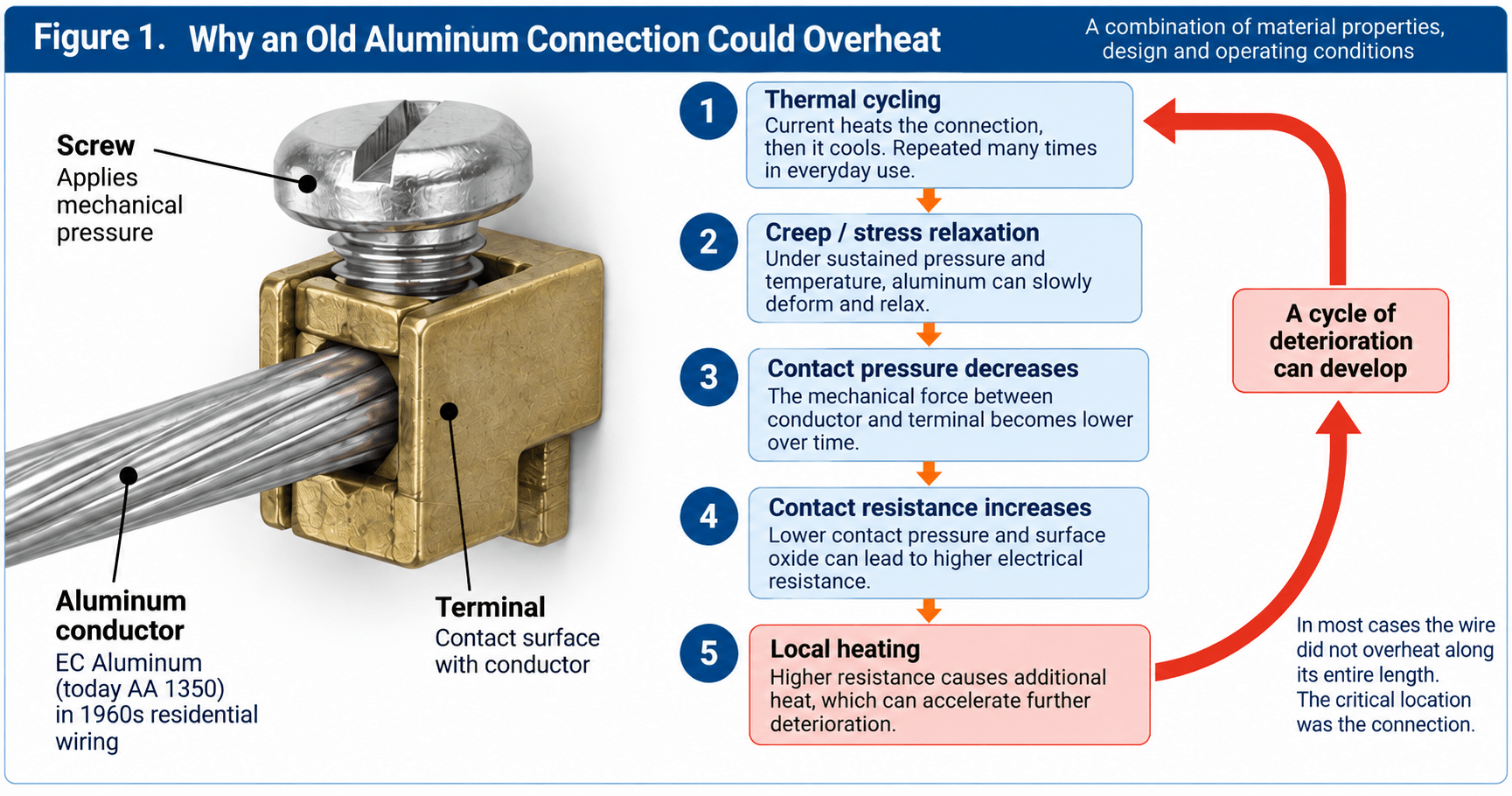 Figure 1. How thermal cycling, creep and loss of contact pressure can lead to overheating in an old aluminium electrical connection.
CO/ALR: Changing the Other Half of the Connection
The electrical industry therefore did not change only the aluminium conductor.
Connection devices also changed.
Special switches and receptacles were developed for aluminium branch-circuit wiring. These devices were marked CO/ALR — Copper/Aluminum Revised.
The CPSC recommended CO/ALR devices when replacement switches or receptacles were required in aluminium-wired homes.
Correct installation was still essential. The conductor had to be stripped without damage, positioned correctly, tightened properly and placed in the electrical box without disturbing the connection.
The lesson was clear:
Better conductor material cannot compensate for a badly designed or badly installed connection.
Engineers Also Changed the Aluminium
At almost the same time that problems with EC aluminum building wire were becoming apparent, American aluminium and cable companies began developing a new generation of conductor alloys.
Southwire began development of its Triple E aluminium in 1968. Alcoa and Olin developed competing conductor alloys during approximately the same period.
Instead of optimizing aluminium mainly for maximum electrical conductivity, metallurgists looked for a better combination of:
- electrical conductivity;
- strength and ductility;
- flexibility;
- thermal stability;
- creep and stress-relaxation behaviour;
- reliable performance at electrical connections.
These developments eventually produced the modern AA-8000 series electrical conductor alloys.
Different developers followed different metallurgical routes. Modern electrical conductor alloys include AA 8030, 8076 and 8176.
Their development is the subject of the next article in this series.
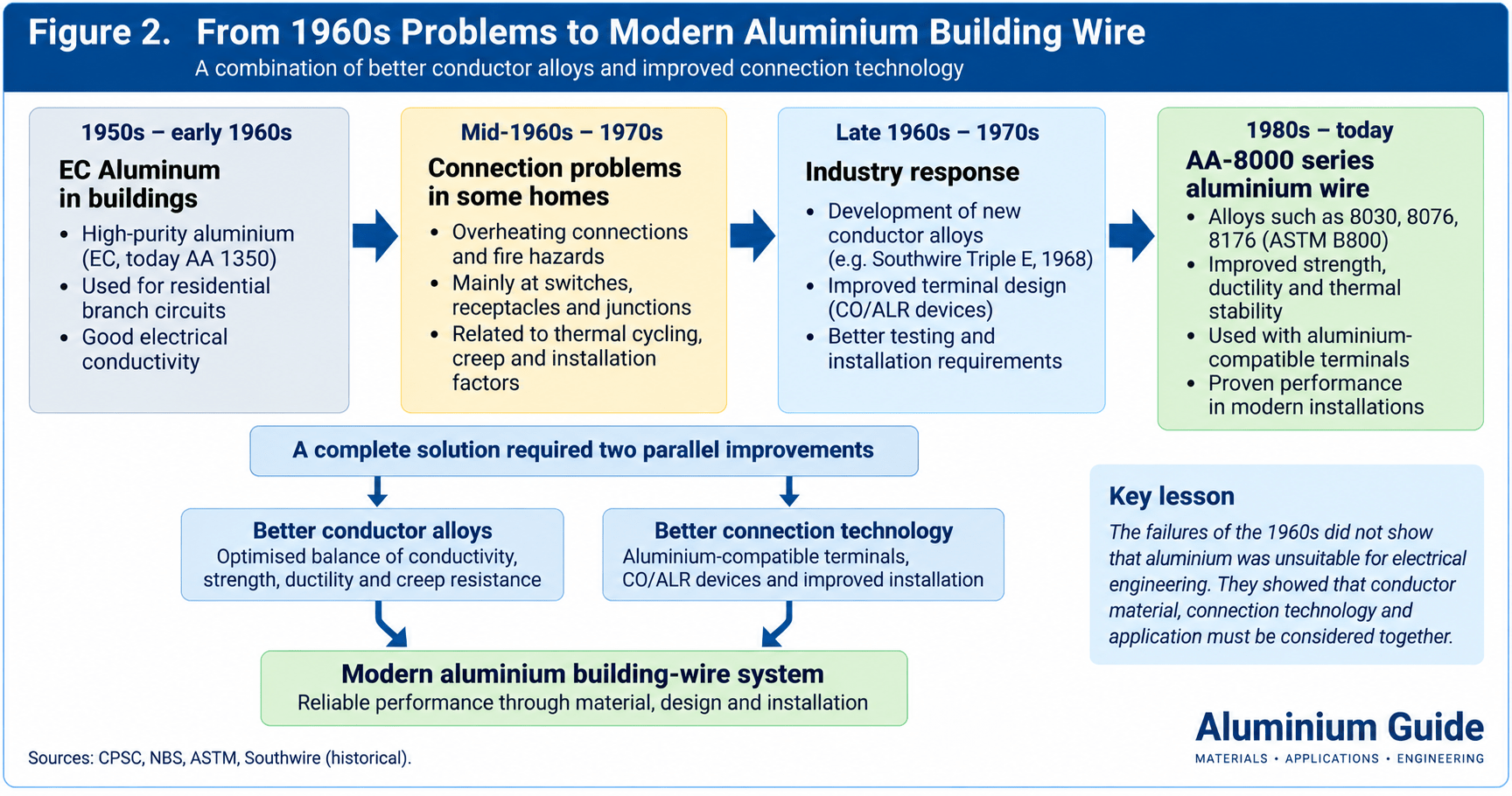 Figure 2. The development from EC aluminum wiring of the 1960s to modern AA-8000 building-wire systems.
AA 1350 Did Not Become Obsolete
This is one of the most important lessons from the story.
AA 1350 should not be described as a failed aluminium alloy.
It remains an important electrical conductor material.
The real question is where and how a conductor is used.
An aluminium conductor in an overhead transmission system operates under very different mechanical and connection conditions from a small solid wire wrapped around the terminal screw of a residential receptacle.
The failures of the 1960s therefore did not prove that aluminium was unsuitable for electrical engineering.
They showed that conductor material, connection technology and application must be considered together.
What Engineers Learned
The history is sometimes summarized as:
“Aluminium replaced copper, caused fires, and was replaced again.”
That misses the engineering lesson.
The old residential system combined:
EC aluminum + small branch-circuit conductors + connection technology of the period + installation variability.
The solution required changes to the whole system:
new aluminium alloys + improved conductor design + aluminium-compatible terminals + better testing and installation requirements.
Modern aluminium building wire is therefore not simply the old 1960s wire with a new name.
The failures helped engineers understand something much broader:
An electrical conductor is not only a material that carries current. It is part of a mechanical, thermal and electrical system that must remain stable for decades.
That lesson led to the development of the AA-8000 series aluminium conductor alloys.
In the next article, we will look at how Southwire, Alcoa and Olin developed competing conductor alloys — and how metallurgy changed from EC aluminum to AA 8030, 8076 and 8176.
References
- U.S. Consumer Product Safety Commission (CPSC), Aluminum Wiring, Publication 516.
- U.S. Consumer Product Safety Commission, Safety Recommendations for Aluminum Wiring in Homes, 1974.
- National Bureau of Standards, Aluminum Wire in Residential Electrical Systems, NBSIR 76-1039, 1976.
- ASTM B800, Standard Specification for 8000 Series Aluminum Alloy Wire for Electrical Purposes — Annealed and Intermediate Tempers.
- ASTM B801, Standard Specification for Concentric-Lay-Stranded Conductors of 8000 Series Aluminum Alloy for Subsequent Covering or Insulation.
- Southwire Company, historical information on the development of Triple E aluminium building wire.
Research Note
This article was prepared with the assistance of AI tools used for literature search, analysis of historical patents, and comparison of technical sources. The author reviewed the technical conclusions and, wherever possible, verified key information against original standards, government publications, patents, and industry sources.
AI was used as a research assistant, not as a technical authority.