Strength Criteria for Wrought and Cast Aluminum Alloys: Structural Design and Material Selection Guide
A comprehensive technical guide to static yield theories, fatigue endurance modeling, and fracture mechanics for wrought and cast aluminum alloys.
Introduction to Mechanical Evaluation of Aluminum Alloys
In structural and mechanical engineering, evaluating the load-bearing capacity of aluminum components is critical to preventing premature structural failure. Engineers classify aluminum alloys into two primary manufacturing categories: wrought alloys (processed through rolling, forging, or extrusion) and cast alloys (formed by pouring molten metal into molds). Due to the fundamental differences in their microstructures, grain alignments, and defect densities, distinct strength criteria must be applied when performing structural safety assessments.
1. Static Strength Criteria
Static strength criteria define the upper stress boundaries at which a material transitions from elastic behavior to permanent plastic deformation (yielding) or ultimate structural fracture under constant or slow-acting loads.
Von Mises Yield Criterion (Distortion Energy Theory)
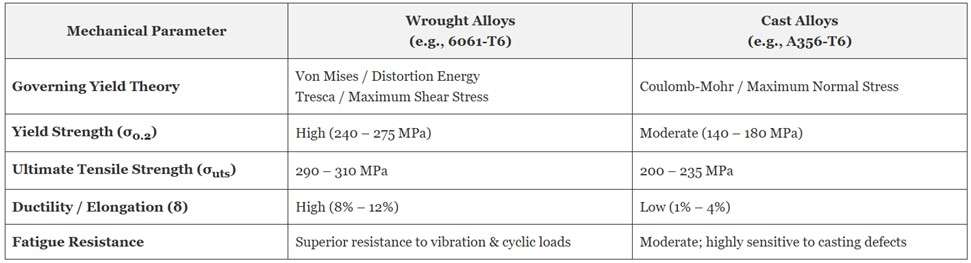
The Von Mises criterion is the standard failure theory applied to ductile wrought aluminum alloys (such as 6061-T6, 6063-T5, and 7075-T6) operating under multiaxial stress states. It posits that yielding occurs when the equivalent distortion energy reaches the material’s uniaxial yield strength limit:
Formula:
σeq = √(σx2 - σx·σy + σy2 + 3·τxy2) ≤ [σ]
Where the allowable design stress [σ] is defined using a safety factor ny relative to the yield strength σ0.2:
[σ] = σ0.2 / ny
Tresca Criterion (Maximum Shear Stress Theory)
The Tresca failure criterion provides a more conservative yield boundary for ductile materials, assuming yielding occurs when the maximum shear stress equals half of the yield strength:
Formula:
τmax = (σ1 - σ3) / 2 ≤ [σ] / 2
Coulomb-Mohr Criterion for Cast Alloys
Cast aluminum alloys (such as A356-T6, A380, or A413) typically display lower ductility and contain microscopic casting porosity. These materials often exhibit an asymmetric failure envelope, where compressive strength (σuc) significantly exceeds tensile strength (σut). Consequently, the Coulomb-Mohr criterion is preferred for cast structures:
Formula:
σeq = σ1 - (σut / σuc) · σ3 ≤ [σ]
2. Fatigue and Cyclic Strength Criteria
Unlike carbon steels, aluminum alloys do not possess a true horizontal endurance limit on their S-N curves (Wöhler curves). Under continuous alternating or vibrating stresses, micro-cracks propagate over time. Therefore, fatigue strength must be calculated based on a finite fatigue strength limit (σ-1N) linked to a specific lifecycle baseline, typically set between 10 million and 50 million cycles.
Symmetrical Cyclic Loading (R = -1)
For fully reversed stress cycles, the effective stress amplitude (σa) must account for geometric stress concentration factors (Kσ) and the fatigue safety factor (nf):
Formula:
σa · Kσ ≤ σ-1N / nf
Asymmetrical Cyclic Loading (Goodman Criterion)
When a component experiences a combined mean static stress (σm) and an alternating cyclic stress amplitude (σa), engineers utilize the linear Goodman relation to determine the allowable fatigue boundary:
Formula:
(σa / σ-1N) + (σm / σuts) ≤ 1 / nf
3. Linear Elastic Fracture Mechanics (LEFM)
For critical aerospace-grade wrought alloys subjected to high tensile stress, micro-flaw propagation governs component lifetime. The stress intensity factor (KI) around a crack of length a must not exceed the plane-strain fracture toughness (KIc):
Formula:
KI = Y · σ · √(π · a) ≤ KIc
Parameter Breakdown:
KI— Stress Intensity Factor (MPa·√m).Y— Dimensionless geometric correction factor (depends on crack shape and component geometry).σ— Applied nominal tensile stress (MPa).π— Mathematical constant Pi (≈ 3.14159).a— Characteristic crack length or half-length of an internal crack (meters).
Comparative Analysis: Wrought vs. Cast Aluminum
Engineering Recommendations for Material Selection
- High-Load Structural and Aerospace Applications: Specify high-strength wrought alloys such as 7075-T6 or 2024-T3. Design calculations should rely on Von Mises yield criteria and LEFM fracture toughness values.
- Medium Structural Loads, Marine, and Welded Frames: Opt for wrought alloys like 6061-T6 or 5083-H111. They provide optimal yield performance, high corrosion resistance, and excellent weldability.
- Complex Geometries and Mass-Produced Components: Select premium cast silumins such as A356-T6 or A357-T6. Use Coulomb-Mohr stress criteria to accommodate the material’s reduced ductility and casting porosity.
Authoritative Engineering References
To access certified material datasheets and standardized testing guidelines:
- MatWeb Material Property Data — Comprehensive engineering material database for technical properties.
- The Aluminum Association — Official standards organization for wrought and cast aluminum designations.
- ASM International — Professional society providing technical handbooks on metals and fracture mechanics.
- Failure of Materials in Mechanical Design: Analysis, Prediction, Prevention, 2nd Edition / Jack A. Collins – Wiley, 1993/