Eurocode 9 Aluminum Alloys: A Guide to Wrought and Cast Types
Aluminum is a fantastic material for modern construction. It is three times lighter than steel, resists rust naturally, and is easy to shape. However, you cannot use just any aluminum for structural engineering. Builders in Europe must follow a strict standard called Eurocode 9 (EN 1999).
This article provides a clear overview of Eurocode 9 aluminum alloys. We will look at the exact engineering reasons why the standard selects certain materials, and explore the two main categories: wrought alloys and cast alloys.
The Strict Selection Principles of Eurocode 9
Aluminum does not have a clear yield point like structural steel. Engineers use a 0.2% proof strength value instead. Engineers use a 0.2% proof strength value instead. For engineering details on how this offset limit is measured, you can read the Aluminium Yield Strength Guide. However, Eurocode 9 excludes many high-strength alloys not because of the yield point itself, but due to four strict engineering criteria:
- The Ultimate-to-Yield Strength Ratio (f_u / f_o): Eurocode 9 requires a safety margin before failure. Allowed alloys (like 6082-T6) have a ratio of f_u / f_o ≥ 1.15. This means if a building is overloaded, the metal stretches and bends noticeably before it breaks, giving a visual warning. High-strength aircraft alloys (like 7075-T6) are banned because their ratio is close to 1.05. They break instantly and brittlely like glass.
- Strength Loss and Recovery in the Welding Zone (HAZ): Welding heat weakens aluminum in the Heat Affected Zone (HAZ). Approved 6xxx and 7xxx series alloys lose some strength, but they experience “natural aging.” Over a few weeks, their crystal structure stabilizes and recovers partial strength automatically. Duralumin alloys (2xxx series) are banned because welding causes hot cracks and destroys 70% of their strength permanently.
- Stress Corrosion Cracking (SCC): Structural elements suffer from constant tension and weather exposure. Approved 5xxx and 6xxx series alloys can handle these loads for decades. However, alloys with more than 5% magnesium develop micro-cracks inside the grain boundaries under stress. The metal looks perfect outside but can suddenly collapse.
- Plasticity at Stress Concentrators: Structural joints have bolt holes and sharp corners. Eurocode 9 requires a minimum elongation capacity of 8% to 12%. This allows the metal to flow locally under high stress and spread the weight safely across the joint. You can find comprehensive engineering research on these strict material properties in the Ductility Analysis of Aluminum Alloy Connections.
1. Wrought Aluminum Alloys in Eurocode 9
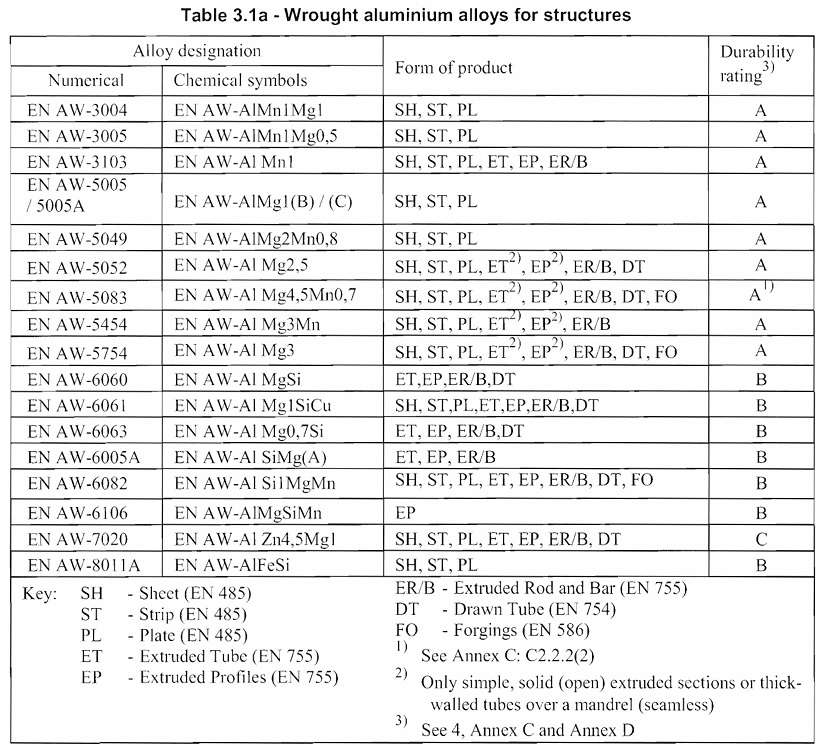
Wrought alloys make up more than 90% of all aluminum used in construction. Workers create them by rolling plates or pressing metal through a die (extrusion). Eurocode 9 divides them into two technological groups based on how they get their strength.
For information on the durability of aluminum alloys, see here.
A. Non-Heat-Treatable Alloys (Work-Hardened)
These alloys get stronger when machines deform them while cold. They offer the highest resistance to rust and are very easy to weld.
- 3xxx Series (Al-Mn): The main alloy here is EN AW-3004. It has medium strength but excellent flexibility. Engineers use it for cold-formed roofing sheets and wall cladding.
- 5xxx Series (Al-Mg): This group includes EN AW-5005, 5052, and 5083. These alloys resist salt water perfectly. They are ideal for marine structures, offshore platforms, and harbor buildings.
B. Heat-Treatable Alloys
These alloys get their final strength from a thermal process called aging (marked as T4, T5, or T6 states).
- 6xxx Series (Al-Mg-Si): This is the most popular group in Eurocode 9. It includes EN AW-6060, 6061, 6063, and 6082. They offer a perfect balance of good strength, great rust protection, and excellent extrusion properties. Builders use them for building frames, glass facades, and roof trusses.
- 7xxx Series (Al-Zn-Mg): The primary alloy is EN AW-7020. This is the strongest alloy group allowed in civil construction. However, it requires careful welding to avoid cracks and reacts faster to environmental rust. It is used for highly loaded parts like mobile military bridges and crane arms.
2. Cast Aluminum Alloys in Eurocode 9
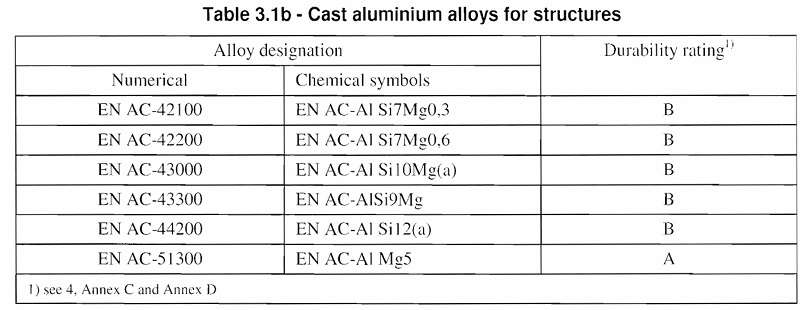
Workers create cast alloys by pouring liquid aluminum directly into specialized molds. Eurocode 9 allows cast aluminum, but limits its use to specific structural joints and nodes.
Cast parts can sometimes have tiny air bubbles inside. Because of this risk, Eurocode 9 uses a strict safety rule. The design strength of a cast part is usually reduced to 70% of the strength of a similar wrought part.
Approved Cast Groups:
- EN AC-4xxxx Series (Al-Si / Silumin): The most common examples are EN AC-42100 and 44200. They liquidize smoothly and fill complex molds perfectly. When you add magnesium, you can heat-treat them to T6 for extra strength.
- Application: Structural joints connecting multiple spatial tubes, heavy hinges for aluminum bridges, and complex anchors for glass facades.
Wrought vs. Cast Alloys: Quick Reference
The table below summarizes the key differences between these two metal groups under the EN 1999 standard.
| Feature | Wrought Alloys (e.g., 6xxx / 7xxx) | Cast Alloys (e.g., Silumin 4xxxx) |
|---|---|---|
| Forming Method | Extrusion, rolling, drawing | Pouring liquid metal into molds |
| Shape Options | Long profiles, sheets, plates | Complex 3D shapes and nodes |
| Typical Yield Strength | High (160 to 350 MPa) | Medium (100 to 240 MPa) |
| Ductility (Elongation) | High (10% to 12% or more) | Low (usually 2% to 6%) |
| Eurocode 9 Status | Primary structural material | Secondary material with safety limits |
Conclusion
Choosing the right Eurocode 9 aluminum alloys requires a balance between strength, manufacturing needs, and environmental conditions. Wrought alloys like the 6xxx series remain the best choice for general structural frames due to their stable HAZ zone recovery. Meanwhile, cast 4xxx series alloys are ideal for intricate connection points where extrusion is impossible.