American vs. European Classification of Cast Aluminium Alloys
The numbers are different, but the metallurgy is often comparable.
Aluminium foundries and design engineers often work with two different alloy designation systems: the American system used by the Aluminum Association (AA) and the European system defined by EN 1706 and the related designation standard EN 1780-1.
The two systems are based on similar metallurgical principles, but their numbering logic is different.
This becomes important when an engineer buys material from another country, changes a supplier, converts an American drawing to European standards, or looks for an equivalent alloy.
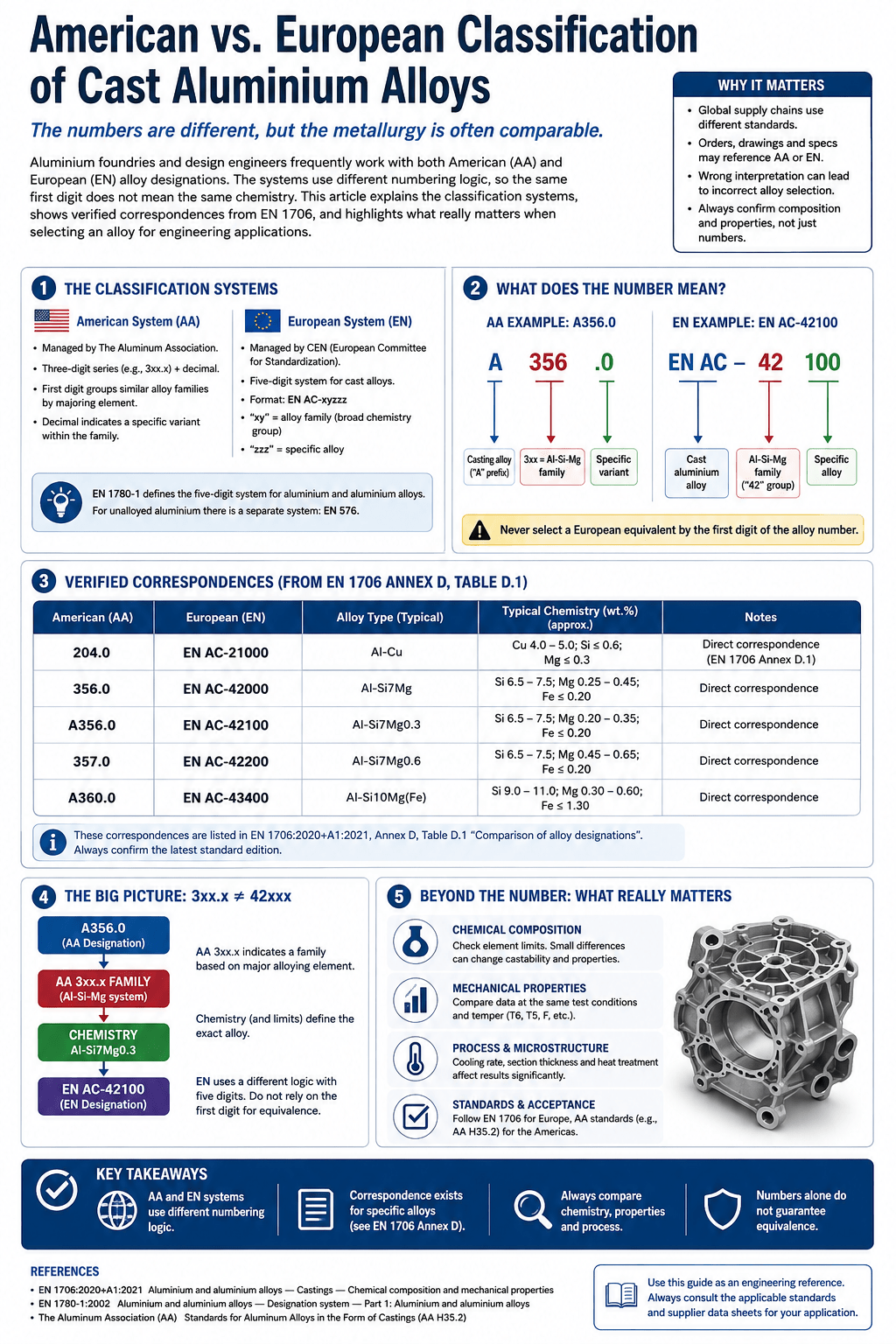
One of the best examples is A356.0. In the American system it belongs to the 3xx.x family. A corresponding European designation is EN AC-42100.
The important lesson is simple:
Do not select an alloy equivalent by the number alone. Compare the chemistry and properties.
1. The American Cast Aluminium Alloy System
The American Aluminum Association uses a numerical designation system for aluminium casting alloys.
The basic designation has the form:
xxx.x
For example:
A356.0
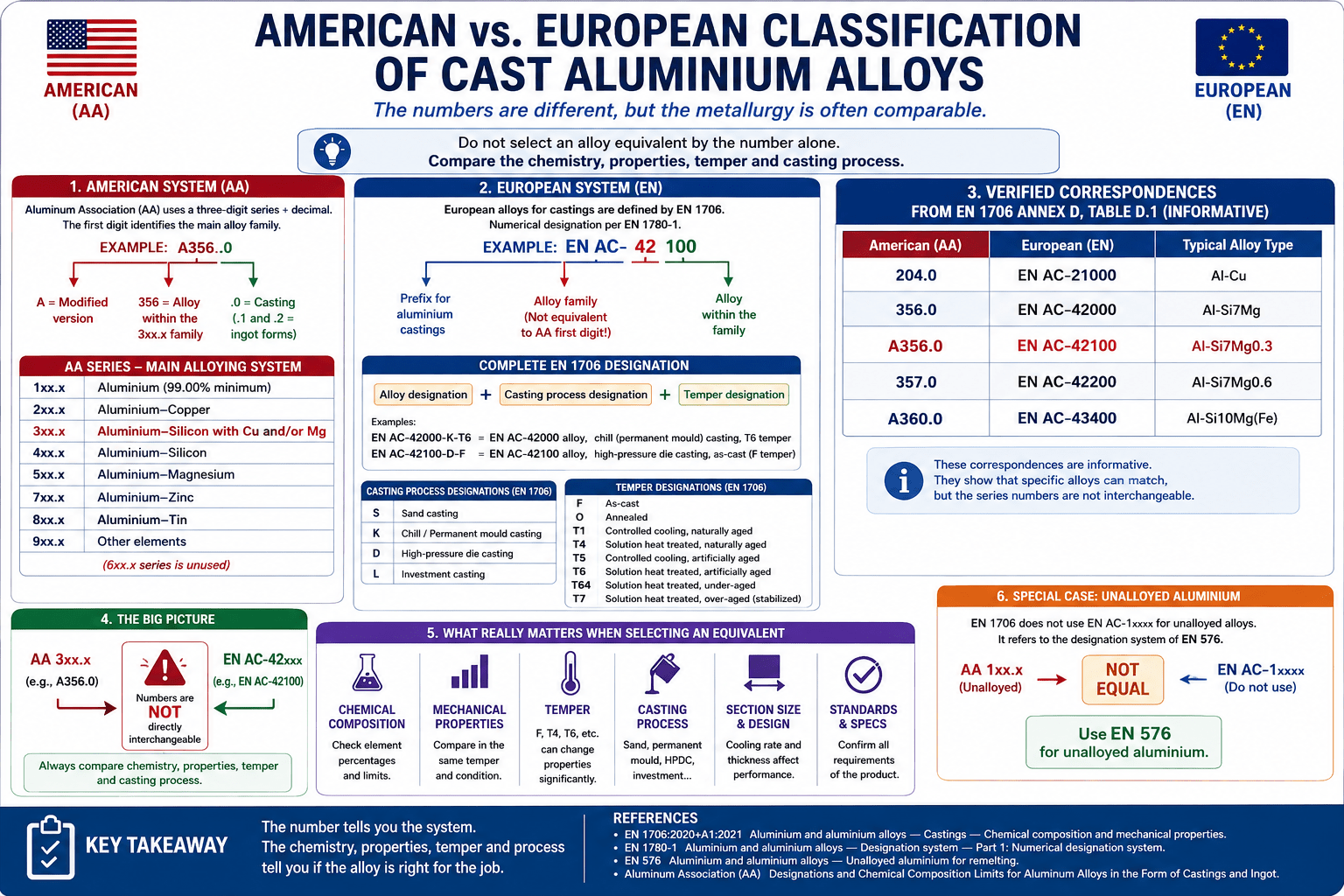
The first digit identifies the main alloy family. The two following digits identify the individual alloy. The digit after the decimal point identifies the product form.
| American series | Main alloying system |
|---|---|
| 1xx.x | Aluminium, 99.00% minimum |
| 2xx.x | Aluminium-copper |
| 3xx.x | Aluminium-silicon with copper and/or magnesium |
| 4xx.x | Aluminium-silicon |
| 5xx.x | Aluminium-magnesium |
| 6xx.x | Unused series |
| 7xx.x | Aluminium-zinc |
| 8xx.x | Aluminium-tin |
| 9xx.x | Other elements |
The Aluminum Association defines the decimal suffix as part of the designation system; .0 identifies a casting, while .1 and .2 are used for foundry ingot designations.
A letter before the number indicates a modification of the original alloy. Therefore, A356.0 and 356.0 belong to the same broad alloy family but are not identical designations.
2. The European System
European aluminium castings are specified primarily through EN 1706. The numerical designation system is based on EN 1780-1, while the chemical-symbol designation system is based on EN 1780-2.
A typical European designation is:
EN AC-42100
The European numerical system uses five digits after the EN AC- prefix.
However, the most important point is that the first digits of the European designation must not be treated as a direct equivalent of the first digit of the American designation.
This is where many material-selection mistakes begin.
3. Why 3xx.x Does Not Mean EN AC-3xxxx
Consider the American alloy:
A356.0
Its American family is:
3xx.x
The 3xx.x family covers aluminium-silicon alloys with copper and/or magnesium.
The corresponding European alloy is:
EN AC-42100
Therefore:
A356.0 → EN AC-42100
Notice the important difference:
3xx.x → 42xxx
There is no contradiction. The two standards divide the alloy families differently.
This is why an engineer should never assume that:
AA 3xx.x = EN AC-3xxxx
The actual alloy chemistry must be considered.
4. Verified American–European Correspondences
EN 1706:2020+A1:2021 includes an informative comparison of alloy designations in Annex D, Table D.1. It gives specific correspondences between EN, ISO, Aluminum Association and JIS designations.
Some useful examples are:
| American AA | European EN | Typical alloy type |
|---|---|---|
| 204.0 | EN AC-21000 | Al-Cu |
| 356.0 | EN AC-42000 | Al-Si7Mg |
| A356.0 | EN AC-42100 | Al-Si7Mg0.3 |
| 357.0 | EN AC-42200 | Al-Si7Mg0.6 |
| A360.0 | EN AC-43400 | Al-Si10Mg(Fe) |
These examples demonstrate an important principle:
The numerical families themselves are not interchangeable, while specific alloy designations can have recognised correspondences.
5. The A356.0 Example
A356.0 is one of the most widely used aluminium casting alloys.
In the American system:
A356.0 → 3xx.x family
Its typical chemistry is based on:
- Silicon: approximately 6.5–7.5%
- Magnesium: approximately 0.25–0.45%
- Low copper content
- Controlled iron content
The European designation is:
EN AC-42100 — AlSi7Mg0.3
This is a very good example of why the first digit cannot be used to find an equivalent.
The American alloy is in the 3xx.x family, while the European designation begins with 42.
EN 1706 Annex D specifically lists A356.0 → EN AC-42100.
6. Why Do the Numbers Differ?
The two systems developed independently and use different classification logic.
The American system first divides alloys into broad families according to the principal alloying elements.
The European system uses a five-digit numerical designation that provides a different subdivision of alloy families.
As a result, alloys with similar chemistry may have quite different numerical designations.
This is not a problem as long as the engineer understands what the designation represents.
7. Chemistry Is More Important Than the Number
When selecting an equivalent alloy, the first comparison should be the chemical composition.
Important elements include:
- Silicon (Si)
- Magnesium (Mg)
- Copper (Cu)
- Iron (Fe)
- Manganese (Mn)
- Zinc (Zn)
- Titanium (Ti)
Small differences in chemistry can influence fluidity, feeding, porosity, corrosion resistance, machinability, weldability and mechanical properties.
8. Mechanical Properties Also Matter
Two alloys with similar chemical composition are not automatically interchangeable.
The engineer should also compare:
- tensile strength;
- yield or proof strength;
- elongation;
- hardness;
- fatigue performance;
- impact or fracture behaviour where relevant.
Properties should be compared in the same temper.
For example, an alloy in the T6 temper cannot simply be compared with an as-cast F temper.
EN 1706 defines F, O, T1, T4, T5, T6, T64 and T7 as temper designations for different heat-treatment conditions.
9. Casting Process Can Change the Answer
The casting process is another important part of alloy selection.
The same alloy may behave differently in:
- sand casting;
- permanent mould casting;
- low-pressure casting;
- high-pressure die casting;
- investment casting.
Cooling rate, section thickness, feeding conditions and heat treatment all influence the final microstructure and mechanical properties.
Therefore, an alloy substitution should consider the complete product specification, not only the alloy name.
EN 1706 also has separate casting process designations: S for sand casting, K for chill/permanent mould casting, D for high-pressure die casting and L for investment casting.
10. Temper Is Part of the Complete European Designation
This is an important point when comparing American and European specifications.
EN 1706 does not treat the alloy number as the complete designation.
The complete designation of a casting includes:
alloy designation + casting process designation + temper designation
For example:
EN AC-42000-K-T6
means an EN AC-42000 alloy, chill/permanent-mould cast, in the T6 temper. EN 1706 explicitly gives this format as an example.
The main EN 1706 temper designations are:
| Temper | Meaning |
|---|---|
| F | As cast |
| O | Annealed |
| T1 | Controlled cooling from casting and naturally aged |
| T4 | Solution heat treated and naturally aged, where applicable |
| T5 | Controlled cooling from casting and artificially aged or over-aged |
| T6 | Solution heat treated and fully artificially aged |
| T64 | Solution heat treated and artificially under-aged |
| T7 | Solution heat treated and artificially over-aged (stabilized) |
These are the terms used by EN 1706 itself.
Therefore, when comparing two international specifications, the engineer should compare not only the alloy but also the temper.
11. Unalloyed Aluminium Is a Special Case
There is another important difference that is easy to miss.
EN 1706 does not simply create an EN AC-1xxxx series for unalloyed aluminium.
For unalloyed grades, EN 1706 refers to the designation system of EN 576.
Therefore, a designation such as:
EN AC-10500
should not be used as a general European equivalent of the American 1xx.x cast-alloy series.
This is a good example of why classification tables must be based on the actual standard and not on a simple numerical extrapolation.
12. Practical Rules for Engineers
When converting an American alloy specification into a European specification, use this sequence:
- Identify the complete American designation.
- Check the chemical composition.
- Find the corresponding EN designation in the applicable standard.
- Compare mechanical properties.
- Check the temper.
- Check the casting process.
- Check section thickness and casting requirements.
- Confirm the product and customer specification.
For a critical component, the substitution should be formally approved rather than based only on a cross-reference table.
13. What Engineers Should Remember
The easiest rule is:
Compare chemistry first. Compare properties second. Compare numbers last.
The number tells you which classification system is being used. It does not, by itself, prove material equivalence.
A complete engineering comparison should include:
Alloy → Chemistry → Casting Process → Temper → Properties → Application
Conclusion
American and European systems classify cast aluminium alloys in different ways.
The American Aluminum Association system uses designations such as A356.0, while the European system uses designations such as EN AC-42100.
Both systems are useful, and many individual alloys have recognised correspondences. But the alloy families are not directly interchangeable by number.
The example of A356.0 is particularly clear:
A356.0 → AlSi7Mg0.3 → EN AC-42100
The American alloy belongs to the 3xx.x family, while the European designation belongs to the 42xxx family.
So the correct engineering approach is not to ask:
“Which European number looks like my American number?”
Instead, ask:
“Which European alloy has the required chemistry, properties, temper and casting performance?”
That approach avoids material-selection mistakes and makes international engineering communication much safer.
References
- EN 1706:2020+A1:2021 — Aluminium and aluminium alloys — Castings — Chemical composition and mechanical properties.
- EN 1780-1 — Aluminium and aluminium alloys — Designation system — Part 1: Numerical designation system.
- EN 576 — Aluminium and aluminium alloys — Unalloyed aluminium for remelting.
- Aluminum Association — Designations and Chemical Composition Limits for Aluminum Alloys in the Form of Castings and Ingot.