Aluminum in Food Industry: Equipment, Packaging, and Storage
Aluminum is one of the most popular metals used in the modern food and beverage industry. Thanks to its lightweight nature, excellent corrosion resistance, and high thermal conductivity, aluminum plays a vital role in food processing, packaging, and long-term storage.
Why Use Aluminum for Food Contact?
Aluminum offers several key physical and chemical advantages that make it suitable for hygienic and demanding environments:
- Corrosion Resistance: Aluminum naturally forms a thin oxide layer (Al2O3) when exposed to air, protecting it from corrosion.
- Thermal Conductivity: It transfers heat quickly and evenly, reducing energy costs during cooking, pasteurization, or freezing.
- Light Weight: Reduces shipping costs for packaged products and makes processing equipment easier to handle.
- Barrier Properties: Aluminum foil completely blocks light, oxygen, moisture, and micro-organisms.
- Recyclability: Aluminum can be recycled infinitely without losing its material properties or purity.
International Food Safety Standards and Regulations
When aluminum comes into contact with food, it must satisfy strict safety requirements to prevent heavy metal migration and maintain product hygiene.
1. European Union (EU)
- EN 602: Aluminum and aluminum alloys — Wrought products — Chemical composition of semi-finished products used for the fabrication of articles for use in contact with foodstuff.
- Framework Regulation (EC) No 1935/2004: Sets general safety requirements for all Food Contact Materials (FCM).
- Council of Europe Resolution CM/Res(2013)9: Defines specific technical guidelines and specific release limits (SRL) for metals in food.
2. United States (FDA)
- FDA 21 CFR Part 175 & Part 178: Cover indirect food additives, protective coatings, and metallic components used in food contact applications.
- GRAS Status: Pure aluminum and specific alloys hold Generally Recognized as Safe (GRAS) status for defined equipment and packaging uses.
Major Aluminum Alloys in the Food Industry
International standard alloys (EN/AA designations) are selected based on mechanical strength, formability, and chemical stability.
| Alloy Series | Common Alloy (AA/EN) | Main Properties | Typical Applications |
|---|---|---|---|
| 1000 Series (Pure Al) |
AA 1050 / AA 1200 | High purity (≥99.5%), excellent corrosion resistance, soft and formable. | Household foil, food containers, tank linings. |
| 3000 Series (Al-Mn) |
AA 3003 / AA 3105 | Good strength, high formability, strong corrosion resistance. | Beverage cans, bakery trays, cooking pots. |
| 5000 Series (Al-Mg) |
AA 5052 / AA 5083 | High strength, sea-water and acid resistance, excellent weldability. | Processing tanks, silos, brewery vessels, fish industry tools. |
| 8000 Series (Al-Fe-Si) |
AA 8011 / AA 8079 | High tensile strength at ultra-low thickness, highly flexible. | Flexible packaging foils, blister packs, dairy caps. |
Key Applications
1. Food Processing Equipment
Industrial food processing plants use aluminum for components where fast heat transfer and low structural weight are essential:
- Baking Sheets and Trays: Aluminum provides uniform baking heat across large batch pans.
- Brewery and Dairy Vessels: High-magnesium alloys (5000 series) resist organic acids and repeated washing cycles.
- Conveyor Frames and Molds: Lightweight frames lower energy consumption for drive motors.
2. Food Packaging
Packaging represents the largest consumer sector of aluminum globally:
- Beverage Cans: Constructed mostly from 3000-series bodies and 5000-series ends. Internal protective lacquers prevent interaction with acidic beverages.
- Flexible Foil: Used in multi-layer laminate pouches (e.g., coffee bags, dry soups, military rations).
- Semi-Rigid Containers: Disposable foil containers for ready-to-eat meals and bakery products.
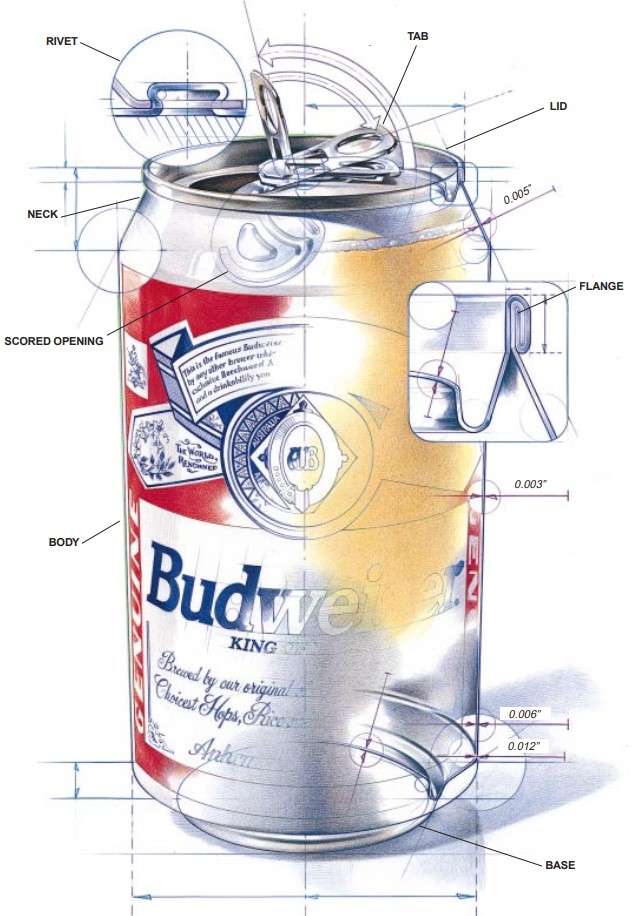
Figure – General view of a typical beverage can and the functions of its various elements
SCIENTIFIC AMERICAN September 1994
3. Storage and Logistics
- Silos and Hoppers: Used for dry bulk storage (flour, grain, sugar) due to smooth non-stick surface properties and spark-free characteristics.
- Shipping Crates and Pallets: Easy to sanitize and wash compared to traditional wooden or plastic pallets.
Surface Treatments and Protective Coatings
Uncoated aluminum can react with highly acidic (pH < 4.5) or highly alkaline (pH > 8.5) foods (such as tomatoes, citrus fruits, or salty brine). To protect both the food quality and the metal surface, specialized treatments are applied:
- Anodizing: An electrochemical process that thickens the natural protective oxide layer, making it non-reactive and highly wear-resistant.
- Polymer Coatings (Epoxy / BPA-NI Lacquers): Applied inside beverage cans and food tins to prevent direct contact between metal and acidic contents.
Official Sources and Documents
- European Committee for Standardization (CEN):
Standard EN 602 — Chemical composition of wrought aluminum for food contact.
CEN Standards Portal - U.S. Food and Drug Administration (FDA):
Code of Federal Regulations Title 21 (CFR 21) — Food Ingredients and Packaging.
FDA CFR Title 21 Database - Council of Europe:
Metals and alloys used in food contact materials and articles (EDQM Technical Guide).
EDQM Publications - European Food Safety Authority (EFSA):
Safety assessment of aluminum from dietary intake.
EFSA Journal