Aluminum 6060 vs. 6063: Differences, Standards, and Uses
The 6000 series aluminum alloys are very popular in Europe. Two main grades dominate the market for extruded profiles: EN AW-6060 (AlMgSi0.5) and EN AW-6063 (AlMg0.7Si) according to EN 573-3. Though they look alike, small differences in their chemical makeup change how they behave during melting, extrusion, and surface finishing.
Chemical Composition (EN 573-3)
According to European norms, both are aluminum-magnesium-silicon alloys, but their element ranges differ slightly:
- Silicon (Si): 6060 has 0,30–0,60%. 6063 has a wider range of 0,20–0,60%.
- Magnesium (Mg): 6060 contains 0,35–0,6%. 6063 contains a higher amount of 0,45–0,9%, giving it a boost in hardening potential.
- Iron (Fe): Max 0,30% for 6060, while 6063 allows up to 0,35%.
- Other elements (Cu, Mn, Cr, Zn, Ti): Kept under 0,10% each, total max 0,15% for both.

Melting and Billet Casting
The melting point for both alloys is approximately 600°C to 650°C. Solidification starts around 610–655°C. During the casting of extrusion ingots (billets), strict control of cooling rates is vital. Because 6060 has a lower alloy content, it is slightly more forgiving during direct chill (DC) casting, showing a lower tendency to hot tearing in larger billet diameters. Billets must be homogenized before extrusion to dissolve magnesium silicide (Mg2Si) particles.
Extrusion Process
Extrusion performance favors 6060 for speed.
- Speed: Alloy 6060 allows a 15–20% higher extrusion speed than 6063 because of its lower overall solute content.
- Complexity: Both handle complex hollow and solid architectural shapes well, but 6060 flows easier through intricate dies with thin walls.
- Quenching: Both allow press-quenching directly from the extrusion temperature container exit, followed by air or water cooling.
Tempers (EN 515)
According to European standard EN 515, these alloys are delivered in several tempers which dictate their final properties:
- O (Annealed): The softest state. The metal is heated to remove internal stresses, offering maximum formability but lowest strength.
- T4 (Solution Heat Treated & Naturally Aged): Cooled quickly after extrusion and aged at room temperature. It remains stable, highly ductile, and easy to bend.
- T5 (Cooled from Extrusion & Artificially Aged): Cooled rapidly right at the press exit, then aged in an oven. This is the most common state for architectural profiles.
- T6 (Solution Heat Treated & Artificially Aged): Heated in a separate furnace (or press-quenched at optimal high temperatures) and fully oven-aged. This state yields maximum mechanical strength.
- T66 (Enhanced T6 Temper): A special European designation for 6060 and 6063. It indicates higher mechanical property guarantees than standard T6, achieved via strict chemical control and optimized cooling.
Aging
Both alloys are heat-treatable (precipitation hardening). Artificial aging is commonly performed to reach T5, T6, or T66 tempers. Profiles are held at roughly 175°C–205°C for 2 to 6 hours. This process precipitates fine Mg2Si needles that lock dislocations and raise final strength. Alloy 6063 responds more intensely to this thermal hardening due to its higher magnesium baseline.
Mechanical Properties (EN 755-2)
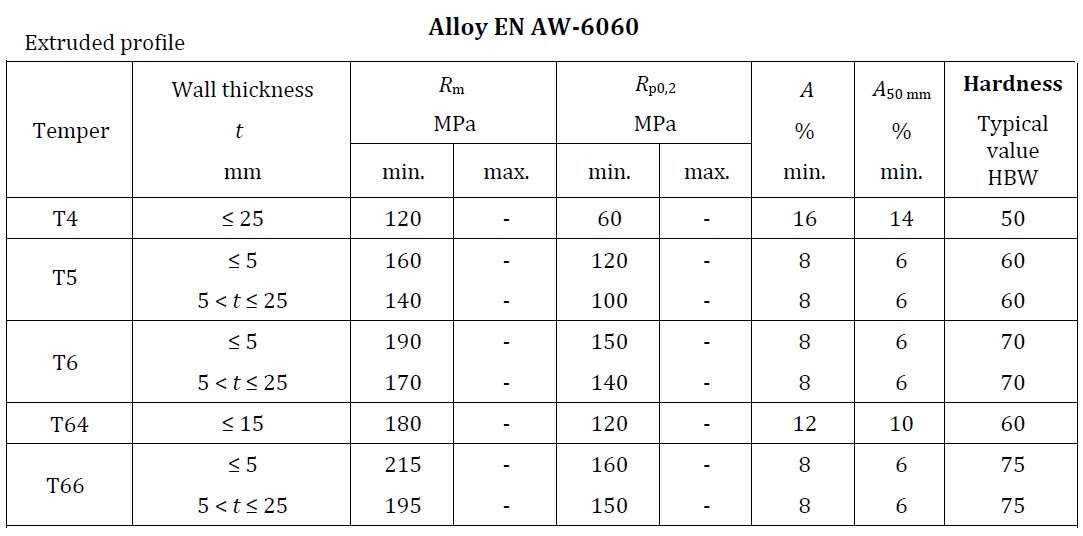
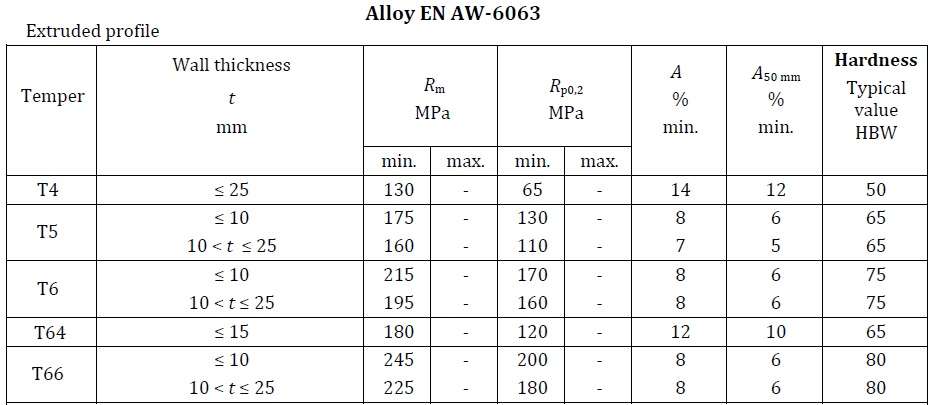
Mechanical limits depend strictly on the material temper and wall thickness:
For wall thickness up to 5 mm:
- 6060-T4: Tensile strength ≥ 120 MPa, Yield strength ≥ 60 MPa, Elongation ≥ 16%.
- 6060-T5: Tensile strength ≥ 160 MPa, Yield strength ≥ 120 MPa, Elongation ≥ 8%.
- 6060-T6 / T66: Tensile strength ≥ 190 / 215 MPa, Yield strength ≥ 150 / 160 MPa, Elongation ≥ 8 / 6%.
- 6063-T4: Tensile strength ≥ 130 MPa, Yield strength ≥ 65 MPa, Elongation ≥ 14%.
- 6063-T5: Tensile strength ≥ 175 MPa, Yield strength ≥ 130 MPa, Elongation ≥ 8%.
- 6063-T6 / T66: Tensile strength ≥ 215 / 245 MPa, Yield strength ≥ 170 / 200 MPa, Elongation ≥ 8 / 8%.
Corrosion Resistance
Both 6060 and 6063 display identical, excellent atmospheric corrosion resistance. A natural protective oxide layer forms instantly. They perform very well in urban and industrial environments, though neither is rated for direct, long-term immersion in untreated marine saltwater without protective coatings.
Anodizing: Matte and Bright Finishes
Surface finishing via anodizing follows QUALANOD standards:
- Matte Anodizing: Alloy 6060 often delivers a finer, more uniform micro-structure after etching, which reduces visible defects in standard architectural matte finishes.
- Bright Anodizing: Alloy 6063 is preferred for high-end chemical or electrochemical brightening. Its response to bright-dipping creates a cleaner, highly reflective surface with fewer iron-intermetallic streaks.
Summary Selection Guide
Choose EN AW-6060 for cost-sensitive, highly detailed architectural shapes where high structural load is not the primary requirement. Choose EN AW-6063 when higher structural rigidity (T5/T6/T66) or brilliant mirror anodizing is mandatory.