How AA-8000 Aluminium Alloys Were Born: From EC Aluminum to 8030, 8076 and 8176
The problems with aluminium residential wiring in the United States during the 1960s created an unusual metallurgical challenge.
Aluminium was already an excellent electrical conductor. The old EC — Electrical Conductor — aluminum offered high conductivity and low weight.
So engineers did not simply need a “better conductor”.
They needed aluminium that could combine high electrical conductivity with better mechanical behaviour in building-wire applications.
Beginning around 1968, several American companies attacked this problem independently.
Southwire, Alcoa and Olin developed different aluminium conductor alloys and manufacturing processes. These developments became associated with alloys later standardized within the AA-8000 series.
The interesting part is that they did not use the same metallurgical solution.
The Problem with EC Aluminum
The material historically known in the United States as EC aluminum (Electrical Conductor aluminum) is today designated AA 1350.
Its basic philosophy was simple:
high aluminium purity → high electrical conductivity
This makes excellent sense for an electrical conductor, and AA 1350 remains an important conductor material today.
But small building wire requires more than conductivity.
A conductor must also be drawn into wire, bent during installation, held under pressure in a terminal and exposed to repeated heating and cooling during service.
With relatively pure aluminium, increasing strength by cold working creates another problem:
more cold work → higher strength → lower ductility and formability
The challenge was therefore to obtain strength and mechanical stability without losing too much conductivity or flexibility.
1968: Southwire Develops Triple E
One of the earliest developments came from Southwire.
Work on its new conductor material, later known as Triple E, began in 1968.
The concept was surprisingly simple: increase the iron content of aluminium and carefully control processing.
In an early Southwire patent, conventional EC aluminum contained about 0.18% Fe. An experimental new conductor contained about 0.45% Fe.
Why deliberately add more iron to an electrical conductor?
Because iron could help control the microstructure.
During casting and subsequent processing, iron forms very small Fe-containing particles in the aluminium. Southwire found that particle size and distribution were critical.
The manufacturing route was therefore part of the alloy design:
continuous casting → hot rolling → cold drawing → controlled final annealing
The result was not simply “aluminium with more iron”. It was an engineered combination of composition, microstructure and processing.
This Southwire development is associated with the alloy later standardized as AA 8176. ASTM B800 links AA 8176 with Southwire reissue patents RE 28,419 and RE 30,465, which belong to the patent family originating from this early development work.
What Did Southwire Gain?
The early patent data are particularly interesting.
At approximately comparable tensile strength, conventional EC aluminum could have elongation around 8%, while experimental Al-Fe conductors reached much higher elongation values.
The new material also showed improved bendability and resistance to repeated bending.
This was important for building wire.
An electrician must pull, bend and position the conductor without damaging it. At the same time, the wire must retain adequate mechanical strength.
Southwire had therefore improved the balance:
conductivity + strength + elongation + bendability
while maintaining electrical conductivity around 61% IACS.
The purpose was not to make aluminium more conductive.
It was to make an electrical conductor with better overall engineering properties.
Alcoa Takes Another Route: AA 8076
Alcoa approached the problem differently.
A patent filed by metallurgist Harold Y. Hunsicker in 1969 described aluminium conductor alloys using combinations of iron with magnesium and/or other strengthening elements.
This patent is associated in ASTM B800 with AA 8076, an alloy registered by the Aluminum Association in 1972.
Its standardized chemistry is based mainly on:
Al + Fe + Mg
Iron contributes to control of the microstructure, while a small amount of magnesium provides additional strengthening through the aluminium solid solution.
This creates another metallurgical compromise.
Magnesium can improve mechanical properties, but dissolved alloying elements also reduce electrical conductivity.
The amount must therefore be carefully controlled.
The Alcoa route illustrates an important principle of conductor-alloy design: a small sacrifice in maximum conductivity can be acceptable when it produces a better overall balance of mechanical and electrical properties.
Olin Develops the More Complex AA 8030
Olin Corporation followed a third route.
Its patent family goes back to development work started in 1968. ASTM B800 associates Olin patent US 3,711,339 with AA 8030, which was later registered by the Aluminum Association in 1975.
The chemistry was more complex:
Al + Fe + Cu + small additions including B
The metallurgical idea was also more sophisticated.
Iron, silicon and boron were used to produce a fine dispersion of particles, while copper was intended to remain largely in solid solution in the aluminium matrix.
These mechanisms performed different jobs.
The fine particles helped stabilize the microstructure and control grain growth.
Copper provided solid-solution strengthening.
At the same time, precipitation of other elements reduced the amount remaining dissolved in the aluminium matrix, helping preserve electrical conductivity.
Creep and Stress Relaxation Enter the Design
The Olin patent is particularly important historically because it explicitly discusses creep and stress relaxation.
These properties matter when a conductor is held under mechanical pressure in a terminal.
If the aluminium slowly deforms or the internal stress relaxes, contact pressure can decrease.
That can contribute to increased electrical resistance and heating.
Olin specifically connected improved room-temperature creep and relaxation behaviour with applications involving spring and screw-type electrical connections.
This gives direct evidence from the development period that metallurgists were already considering termination stability when designing new conductor alloys.
However, creep was not the only objective.
The same patents discuss conductivity, strength, formability, grain structure and thermal stability.
The AA-8000 story therefore cannot be reduced to “new aluminium that does not creep”.
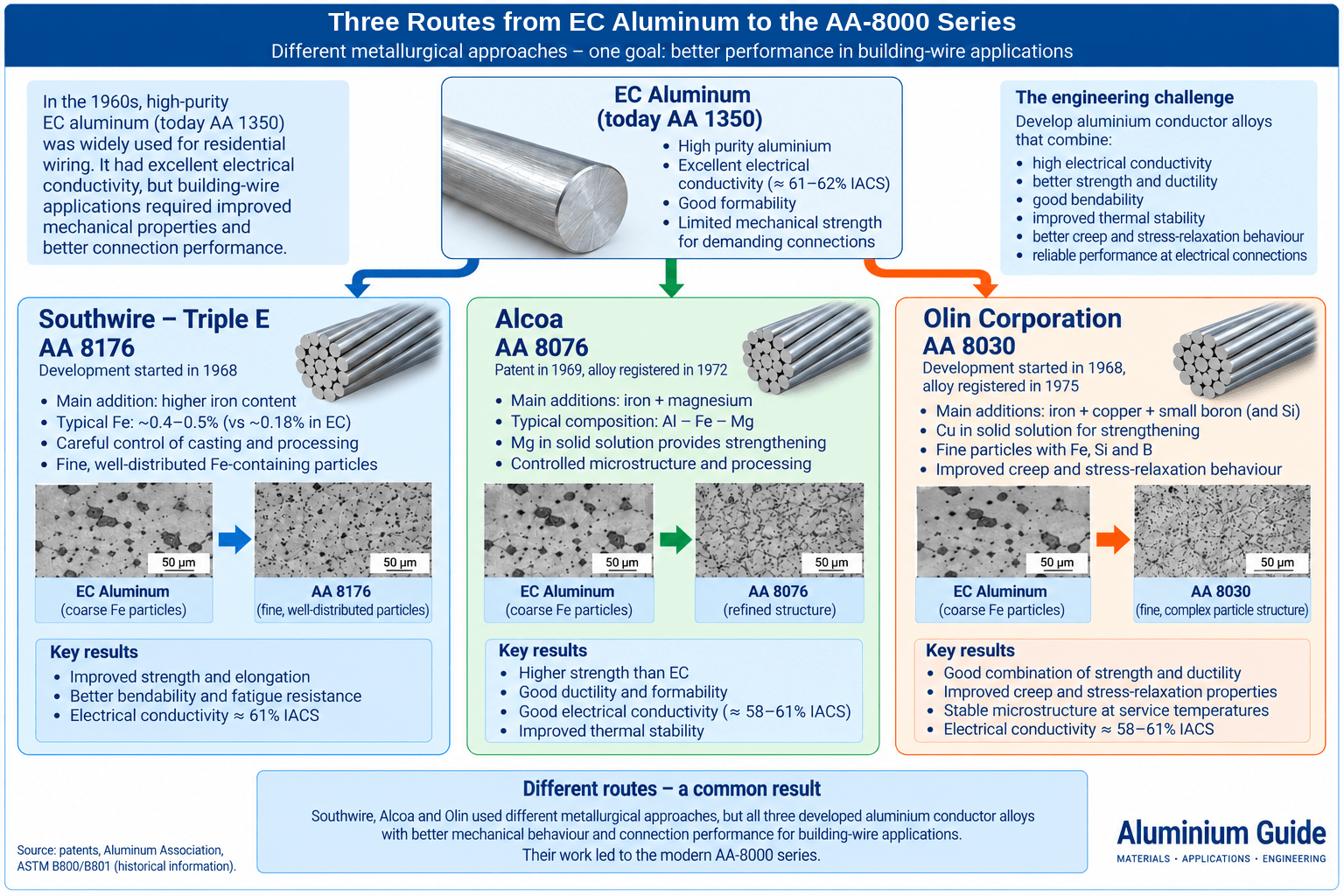
Three Metallurgical Strategies
The three developments can be simplified as follows:
| Development | Later standardized alloy | Main metallurgical approach |
|---|---|---|
| Southwire / Triple E | AA 8176 | Al-Fe + strong control of processing and particle structure |
| Alcoa / Hunsicker development | AA 8076 | Al-Fe-Mg |
| Olin / Besel-Setzer development | AA 8030 | Al-Fe-Cu-B + precipitation and solid-solution strengthening |
These were not simply three versions of the same alloy.
They represented different approaches to a similar engineering problem.
Southwire relied strongly on Fe-containing particle control and thermomechanical processing.
Alcoa combined Fe with Mg.
Olin used a more complex combination of precipitation, grain control and Cu solid-solution strengthening.
Importantly, the proprietary materials described in the early patents should not be treated as if they already had their later Aluminum Association designations. Development, patenting, commercialization and formal alloy registration occurred at different times.
Conductivity Was No Longer the Only Target
This is perhaps the most important change in philosophy.
For traditional EC aluminum, the central idea was:
purity → conductivity
For the new generation of conductor alloys, the target became:
conductivity + strength + ductility + thermal stability + creep behaviour + connection reliability
Adding Fe, Cu or Mg could reduce ideal electrical conductivity.
But a modest reduction was acceptable if the conductor became mechanically more stable and more suitable for building-wire service.
The objective was no longer simply to produce aluminium with the highest possible conductivity.
It was to produce the best electrical conductor as an engineering product.
From Proprietary Developments to AA-8000 Alloys
The transition did not happen overnight.
Companies first developed proprietary compositions and manufacturing processes. Patent applications were filed, experimental and commercial conductors followed, and standardized Aluminum Association alloy designations appeared later.
Important dates include:
1968 — early Southwire and Olin development work
1969 — Alcoa Hunsicker patent application
1972 — AA 8076 registered
1975 — AA 8030 registered
1976 — AA 8176 registered
This distinction is important.
The year an alloy concept was developed is not necessarily the same as the year a patent was filed, a commercial product appeared or an Aluminum Association designation was registered.
Later, the electrical industry incorporated the new alloy family into standards and electrical codes.
ASTM B800 now covers 8000-series aluminium alloy wire for electrical purposes, while ASTM B801 covers stranded conductors manufactured from these alloys.
More Than a New Alloy
The development of the AA-8000 series was not simply a change from pure aluminium to alloyed aluminium.
It represented a different way of designing an electrical conductor.
Composition, particle structure, grain size, casting, rolling, drawing and annealing became parts of one engineering system.
The lessons learned from earlier building-wire experience pushed metallurgists to consider not only how efficiently aluminium carries current, but also how the conductor behaves mechanically during manufacturing, installation and decades of service.
That is the real significance of the AA-8000 series.
EC aluminum was optimized primarily as an electrical conductor material. The new AA-8000 alloys were engineered for a broader combination of electrical, mechanical and service requirements.
In the next article, we will look at how these alloys are used today — including ASTM B800/B801, NEC requirements, compact-stranded conductors and modern aluminium-compatible terminations.
References
- Southwire Company / R. J. Schoerner. Aluminum Alloy Wire, US Patent 3,512,221, 1970.
- Southwire Company. Reissue Patent RE 28,419.
- Southwire Company. Reissue Patent RE 30,465 — Aluminum Alloy Wire.
- H. Y. Hunsicker / Aluminum Company of America (Alcoa). Aluminum Conductor Wire, US Patent 3,697,260, 1972.
- F. A. Besel and W. C. Setzer / Olin Corporation. Aluminum Alloy Conductor, US Patent 3,711,339, 1973.
- The Aluminum Association. International Alloy Designations and Chemical Composition Limits for Wrought Aluminum and Wrought Aluminum Alloys — Teal Sheets.
- ASTM International. ASTM B800 — Standard Specification for 8000 Series Aluminum Alloy Wire for Electrical Purposes — Annealed and Intermediate Tempers.
- ASTM International. ASTM B801 — Standard Specification for Concentric-Lay-Stranded Conductors of 8000 Series Aluminum Alloy for Subsequent Covering or Insulation.
- Southwire Company. Historical information on the development of Triple E aluminium building wire.
Research Note
This article was prepared with the assistance of AI tools used for literature search, analysis of historical patents, and comparison of technical sources. The author reviewed the technical conclusions and, wherever possible, verified key information against original standards, patents and industry sources.
AI was used as a research assistant, not as a technical authority.