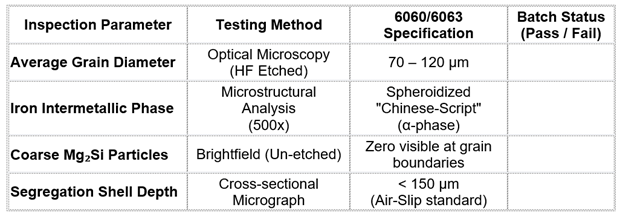
6060/6063 Alloy Extrusion Billet – Microstructure Checklist
Below is the verified 6060/6063 Billet Extrusion-Readiness Microstructure Checklist integrated with authoritative academic and industrial research citations.
The sources from metallurgy journals and research institutions are linked directly within each section to validate the microstructural limits required on the foundry floor.
Every cast log (homogenized billet batch) must pass metallographic inspection against the following criteria before being released to the extrusion press logs.
Grain Structure & Size Control
- Target Grain Size (Alloy 6060): Average grain diameter must be 80–130 μm.
- Target Grain Size (Alloy 6063): Stricter target of 70–100 μm due to higher magnesium and silicon loading.
- Morphology Requirement: 100% strictly equiaxed grain structure without columnar or feather grain deviations.
- Rejection Criteria: Presence of a coarse-grained outer ring or localized “Fir-Tree” (peripheral coarse grain) structures along the billet rim.
- Extrusion Impact: Coarse or non-uniform grain structures in 6060/6063 alloys generate an “orange peel” surface defect on thin-walled profiles during downstream stretching, bending, or anodizing.
Homogenization Efficiency & Iron-Phase Transformation
Iron (Fe) is an unavoidable impurity in commercial aluminum scrap that forms intermetallic compounds. Homogenization must convert the brittle phase variants into ductile alternatives.
- Target Phase: > 98% α-AlFeSi (Al₁₅(Fe,Mn)₃Si₂). This phase displays a rounded, “chinese-script” morphology that deforms smoothly during hot working.
- Critical Limit (Rejection): Residual β-AlFeSi (Al₅FeSi) phase exceeding 2–3%. This phase forms sharp, brittle, needle-like platelets.
- Extrusion Impact: As documented in studies from the Journal of Materials Science and ResearchGate, residual β-phase needles scratch the die bearing surfaces and cause aluminum adherence (“pick-up” defects). This causes surface tearing, premature die lines, and decreases maximum allowable extrusion speeds by 15–20%.
State of the Strengthening Phase (Mg₂Si Precipitates)
Alloys 6060 and 6063 are age-hardenable systems; their final mechanical properties depend entirely on the controlled distribution of Magnesium Silicide (Mg₂Si).
- Target State: Mg₂Si must be fully dissolved into the aluminum matrix (solid solution) or present as ultra-fine, sub-micron precipitates invisible under standard optical microscopes.
- Critical Limit (Rejection): Presence of coarse, dark-grey Mg₂Si plates or continuous grain boundary chains (particle size > 1–2 μm).
- Root Cause: Inadequate cooling rates after homogenization through the critical temperature range of 450°C down to 250°C. According to research compiled in ScienceDirect and UPCommons, the cooling rate must strictly exceed 250°C/hour to prevent premature, oversized Mg₂Si clusters.
- Extrusion Impact: Coarse Mg₂Si particles act as rigid obstacles, drastically increasing the breakthrough pressure of the press. The metal becomes overly “stiff,” causing extrusion speed to drop, and preventing the profiles from reaching full T5/T6 hardness properties after artificial aging.
Surface Segregation Layer (Inverse Segregation Shell)
- For Air-Slip Cast Billets: Billet skin segregation depth (enriched with Mg and Si) must be < 150–200 μm.
- For Conventional Mold Billets: The shell can reach 600–800 μm. These billets must be mechanically scalped prior to extrusion.
- Extrusion Impact: Research on ResearchGate on Inverse Segregation shows that if an un-scalped segregation shell enters the press container, it flows directly into the surface layers of the profile, causing structural lamination and dark surface streaks after decorative anodizing.
Metallographic Quality Control (QC) Log Template